Tensors, shapes & broadcasting¶
Why this matters at staff level. In a 45-minute coding round you will not be asked to invent an algorithm; you will be asked to write multi-head attention, or a masked cross-entropy, or a gather over token indices, and the only thing standing between you and a working answer is shape fluency. Interviewers watch for two signals: do you annotate shapes as you go, and do you know which operations copy memory. A candidate who writes
(B, T, H, d_head)in a comment, then explains why.transpose(1, 2)needs.contiguous()before.view(), has already answered three follow-ups in advance.
TL;DR: the interview card¶
- Broadcasting rule: align shapes from the right; a missing leading dimension counts as 1; a dimension of size 1 is stretched (a stride-0 view, no copy); anything else is an error.
(3,4) + (4,) → (3,4);(3,1) * (1,4) → (3,4)(outer product);(B,1,1,T) + (B,H,T,T) → (B,H,T,T)(mask). - Identical in NumPy and PyTorch.
keepdims=True(NumPy) /keepdim=True(torch) is what keeps a reduction broadcastable back against the original, omit it and you broadcast along the wrong axis, silently. - Matmul batching:
A @ Btreats all but the last two dims as batch and broadcasts them.(B,H,T,d) @ (B,H,d,T) → (B,H,T,T).(1,H,d,d)weights broadcast over the batch for free. - Reshape vs transpose:
reshape/viewreinterpret the linear buffer (row-major order preserved);transpose/permutechange strides without moving data.viewrequires contiguity;reshapecopies if needed. After a transpose you need.contiguous()before.view(). - Heads:
(B,T,d_model) → view(B,T,H,d_head) → transpose(1,2) → (B,H,T,d_head); back:transpose(1,2) → contiguous → view(B,T,d_model). Neverview(B,H,T,d_head)directly, that interleaves tokens and heads. - einsum: a repeated index is contracted (summed over), and any index kept in the output survives.
"bhtd,bhsd->bhts"= for each batch and head, dot query \(t\) with key \(s\) over \(d\). - Gather:
take_along_axis(log_probs, targets[:,:,None], axis=-1)[:,:,0]→(B,T)token log-probs. The index tensor must have the same rank as the source. - One-hot:
(targets[:,None] == arange(K)[None,:])→(N,K). In practice never materialise it for cross-entropy, index instead. - Cost of a copy: a
(B,H,T,d).contiguous()at \(B{=}8, H{=}32, T{=}4096, d{=}128\) in bf16 moves 8 GB through HBM. Shape bugs are correctness problems; shape copies are performance problems. - Cross-link: the drills here feed Part XVI: shape & broadcasting drills and the NumPy ↔ PyTorch cheat sheet.
1. Intuition first¶
A tensor is two things: a flat buffer of numbers, and a shape plus strides that says how to
interpret it. np.arange(12).reshape(3, 4) is the buffer 0..11 with shape (3,4) and strides
(4,1), "to move one row, skip 4 elements; to move one column, skip 1". Every shape operation is
either a reinterpretation of that metadata (free) or a rewrite of the buffer (expensive).
Broadcasting is metadata too. When you add a (4,) vector to a (3,4) matrix, NumPy does not build
three copies of the vector; it sets that axis's stride to 0, so every row read lands on the same
four numbers. That is why broadcasting is free in memory and why (3,1) * (1,4) produces a full
\(3\times4\) outer product from 7 numbers.
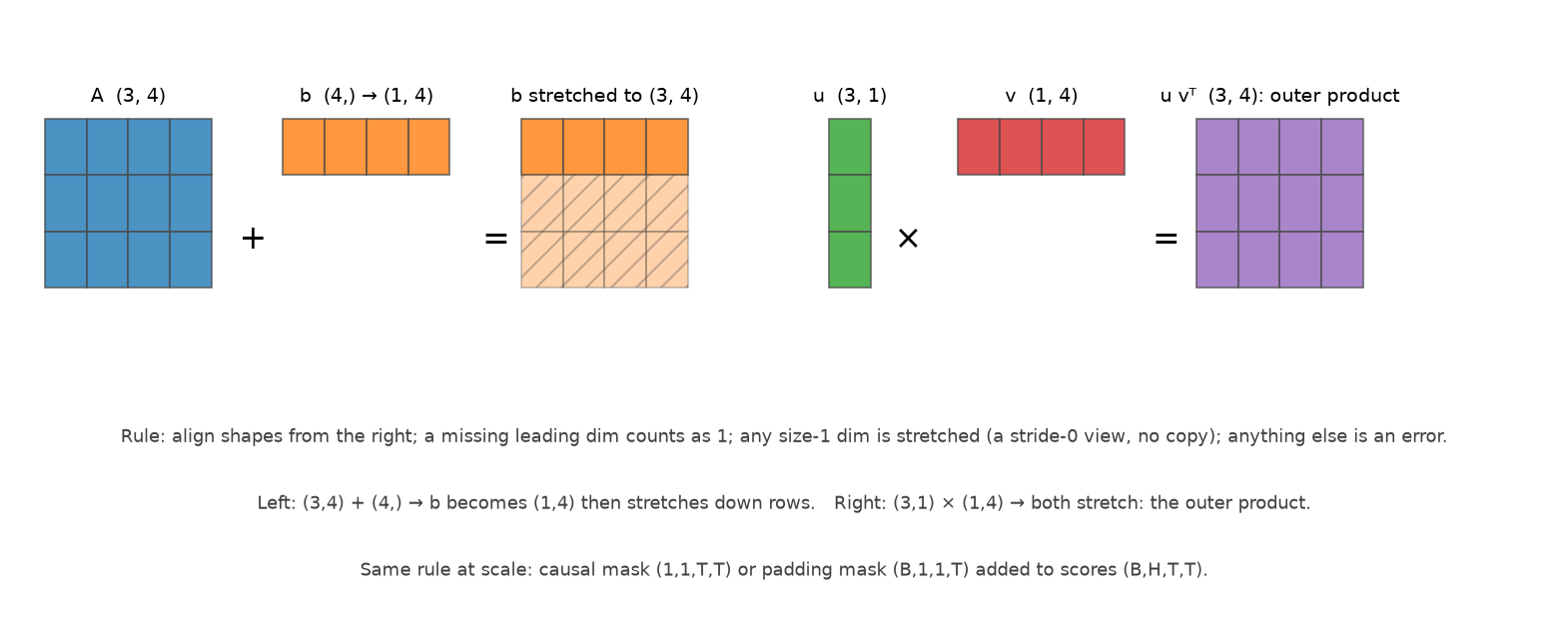
Left: (3,4) + (4,), the vector gains a leading 1, then stretches down the rows (hatched cells are
the stride-0 view, not copies). Right: (3,1) × (1,4), both operands stretch, producing the outer
product. The same rule handles a causal mask (1,1,T,T) or a padding mask (B,1,1,T) added to
attention scores (B,H,T,T).
The single most common bug in this area has a two-line reproduction:
x = np.random.randn(3, 4)          # (3, 4)
bad  = x - x.mean(axis=1)          # (3,4) - (3,)  -> (3,4) but WRONG: (3,) aligns with the 4-axis
good = x - x.mean(axis=1, keepdims=True)  # (3,4) - (3,1) -> (3,4), rows centred
The first line does not crash, (3,) happens to be broadcastable against (3,4) only because
\(3 \ne 4\) would have raised. Make the shapes (4,5) and it raises; make them (4,4) and it silently
subtracts the row means from the columns. This is why keepdims=True is not a style preference.
2. The math¶
2.1 The broadcasting rule, precisely¶
Two shapes are broadcast-compatible if, when right-aligned and left-padded with 1s, every dimension pair is either equal or contains a 1. The result takes the max of each pair:
Mechanically: a size-1 axis gets stride 0 and is read repeatedly; a missing axis is inserted as size 1. Nothing is copied, the broadcast result is materialised only when the operation writes its output. Consequences worth stating in an interview:
- Broadcasting is not commutative with reductions:
(A * B).sum(axis=0)andA.sum(axis=0) * Bdiffer unlessBis constant along axis 0. - An in-place op cannot broadcast its output:
a += brequiresbto broadcast toa's shape, not the reverse. np.newaxis/Noneinserts a size-1 axis;squeezeremoves them. Most shape bugs are fixed by one deliberateNone.
2.2 Memory layout: reshape, view, transpose, permute, contiguous¶
Row-major ("C order") means the last index varies fastest. For shape \((d_0, d_1, \dots, d_{n-1})\) the element at index \((i_0,\dots,i_{n-1})\) sits at linear offset \(\sum_k i_k\,s_k\) with default strides \(s_k = \prod_{j>k} d_j\).
| Operation | What changes | Copies? | Notes |
|---|---|---|---|
reshape(shape) |
Shape, strides recomputed | Only if it must | Preserves the linear order of elements |
view(shape) (torch) |
Shape only | Never: raises instead | Requires the tensor to be contiguous |
transpose(i,j) / .T |
Swaps two strides | Never | Result is generally non-contiguous |
permute(*dims) (torch) |
Reorders all strides | Never | Same |
contiguous() |
Rewrites the buffer in C order | Yes | The explicit cost you pay before view |
expand (torch) |
Sets stride 0 | Never | Broadcasting, made explicit; read-only in practice |
repeat / tile |
Materialises copies | Yes | Use expand unless you need real memory |
flatten / ravel |
Collapse to 1-D | ravel may return a view; flatten copies |
NumPy-specific distinction |
The rule to say out loud: reshape preserves the order in which elements appear in memory; transpose
changes which element is "next". That is why they do not commute, and why
x.transpose(1, 2).view(B, T, d_model)   # RuntimeError: view size is not compatible...
x.transpose(1, 2).contiguous().view(B, T, d_model)   # correct, and pays for a copy
x.transpose(1, 2).reshape(B, T, d_model)             # same result; reshape copies silently
reshape is the forgiving version, which is exactly why some codebases mandate view: it fails loudly
where a copy would have been inserted, so the copies you pay for are the ones you chose.
2.3 Batched matmul¶
A @ B with \(\text{ndim} > 2\) contracts the last axis of A with the second-to-last of B and treats
all leading axes as batch, broadcasting them:
The second form is a linear layer: the weight has no batch axes, so it broadcasts over every batch and token. A weight of shape \((1, H, d, d)\) against activations \((B, H, T, d)\) broadcasts over \(B\) for free: per-head weights with no replication. FLOPs are \(2\cdot\prod(\text{batch dims})\cdot T\cdot S\cdot d\); memory for the output is the product of the output shape, which is where \(T^2\) bites.
2.4 einsum, term by term¶
np.einsum(spec, *operands). Read the spec as: every letter is an index; letters appearing in the
inputs but not in the output are summed over; letters in the output are kept.
"bhtd,bhsd->bhts"
 ││││ ││││  ││││
 ││││ ││││  │││└─ s: key position      (kept)
 ││││ ││││  ││└── t: query position    (kept)
 ││││ ││││  │└─── h: head              (kept, batched)
 ││││ ││││  └──── b: batch             (kept, batched)
 ││││ └┴┴┴─ second operand K: (B, H, S, d)
 └┴┴┴────── first  operand Q: (B, H, T, d)
d appears in both inputs and not in the output → it is contracted (summed): the result is
\(S_{b,h,t,s} = \sum_d Q_{b,h,t,d}K_{b,h,s,d}\), i.e. \(QK^\top\) per batch and head. The second half of
attention is "bhts,bhsd->bhtd": contract over the key position \(s\), keeping the value dimension \(d\),
which is a weighted average of value rows. Other one-liners worth recognising:
| Spec | Meaning |
|---|---|
"ij,jk->ik" |
Plain matmul |
"ij,ij->" |
Frobenius inner product (sum of elementwise product) |
"ii->i" |
Diagonal |
"ii->" |
Trace |
"bi,bj->bij" |
Batched outer product |
"btd,dk->btk" |
Linear layer over a batch of sequences |
"bhtd,bhsd->bhts" |
Attention scores |
Per STYLE.md, production code in this book prefers explicit @/reshape over einsum unless
the string is explained, because a mistyped letter is a silent, shape-valid wrong answer. einsum earns its
place when the alternative is three transposes.
2.5 The head split, and why the order matters¶
Multi-head attention needs each head to attend independently, which means the head axis must be a batch axis for the matmul. Starting from \((B, T, d_{\text{model}})\) with \(d_{\text{model}} = H\cdot d_{\text{head}}\):
The reshape is free and correct because head \(h\)'s slice of each token vector is the contiguous block \([h\cdot d_{\text{head}}: (h{+}1)\cdot d_{\text{head}}]\), the last axis splits cleanly. The transpose then reorders metadata only. Going back reverses both, and the final reshape must copy.
The classic wrong answer is x.reshape(B, H, T, d_head). It is shape-valid and completely wrong: it
reinterprets the buffer so that the first \(T\cdot d_{\text{head}}\) numbers, which are the first
\(T\cdot d_{\text{head}}/d_{\text{model}}\) tokens, all heads, become "head 0". Tokens and heads get
interleaved, the loss still decreases (the model routes around it), and you lose a week. Say the invariant
out loud: the head axis is created by splitting the feature axis, never by regrouping the token axis.
2.6 Masks¶
Additive masks with \(-\infty\) compose by addition and broadcast to the score shape \((B,H,T,T)\):
- Causal: \((1,1,T,T)\), zero on and below the diagonal, \(-\infty\) above. Shared across batch and heads, so it is built once.
- Padding: \((B,1,1,T)\), per example, per key position, shared across heads and queries. A query may not attend to a padded key.
- Combined: just add them; \((1,1,T,T) + (B,1,1,T) \rightarrow (B,1,T,T)\), which then broadcasts against \((B,H,T,T)\).
Use \(-\infty\) (or a large negative number in fp16, where \(-\infty\) can produce NaN after the max-subtraction) and apply it before the softmax, so the masked entries receive exactly zero probability. A row that is entirely masked produces \(0/0\), guard it, or ensure every query has at least one visible key.
Boolean masking with where is the other idiom: np.where(mask, scores, -np.inf). Prefer additive masks
in the forward pass because they compose; prefer boolean for gathering and loss weighting.
2.7 Gather, scatter, one-hot and cross-entropy¶
Given per-position log-probabilities \((B, T, V)\) and target ids \((B, T)\), the log-likelihood of the targets is a gather along the last axis:
In NumPy: np.take_along_axis(log_probs, targets[:, :, None], axis=-1)[:, :, 0]. In PyTorch:
log_probs.gather(2, targets.unsqueeze(-1)).squeeze(-1). The index array must have the same rank as the
source, which is what the [:, :, None] / unsqueeze is for. Scatter is the inverse (write values at
indices); it is how you build sparse targets and how embedding-gradient accumulation works.
The one-hot route (build \((B,T,V)\) one-hot and multiply) is mathematically identical and \(V\times\) more memory: at \(V = 128\)k and \(B\cdot T = 8192\), one-hot in fp32 is 4 TB. Materialise one-hot only for soft targets (label smoothing, distillation) where you genuinely need the full distribution, and even then compute the loss in chunks.
For numerical stability compute cross-entropy from logits with log-sum-exp, never by taking log(softmax(x)):
The gradient is \(p - y\) (chapter 02), which is why the fused form is both faster and more stable.
3. Implementation¶
All in src/mlbook/math/tensor_ops.py. The head split and merge, with the contiguity story in the docstrings:
def split_heads(x: np.ndarray, H: int) -> np.ndarray:
    B, T, d_model = x.shape
    d_head = d_model // H
    x = x.reshape(B, T, H, d_head)  # (B, T, H, d_head) -- free view
    return x.transpose(0, 2, 1, 3)  # (B, H, T, d_head) -- strided view


def merge_heads(x: np.ndarray) -> np.ndarray:
    B, H, T, d_head = x.shape
    x = x.transpose(0, 2, 1, 3)  # (B, T, H, d_head)
    return x.reshape(B, T, H * d_head)  # (B, T, d_model) -- copies
Two lines each, and the comments carry the whole lesson: the first reshape splits the feature axis
(free), the transpose only touches strides (free), and the final reshape after a transpose is the one
that copies. The test asserts split_heads(x, 3)[1, 2, 4] == x[1, 4, 8:12], head 2 of token 4 is the
third contiguous chunk, which is exactly the invariant that the wrong reshape(B,H,T,d) violates.
Masks, built at the shapes that broadcast:
def causal_mask(T: int) -> np.ndarray:
    allowed = np.tril(np.ones((T, T), dtype=bool))  # (T, T) lower-triangular True
    mask = np.where(allowed, 0.0, -np.inf)  # (T, T)
    return mask[None, None, :, :]  # (1, 1, T, T)


def padding_mask(lengths: np.ndarray, T: int) -> np.ndarray:
    positions = np.arange(T)[None, :]  # (1, T)
    valid = positions < lengths[:, None]  # (B, T) True where the key is a real token
    mask = np.where(valid, 0.0, -np.inf)  # (B, T)
    return mask[:, None, None, :]  # (B, 1, 1, T)
positions < lengths[:, None] is a broadcast comparison of (1,T) against (B,1) producing (B,T), the
same trick as the outer product, and the idiomatic way to turn a length vector into a mask without a loop.
Attention with masks, every intermediate annotated:
def masked_attention(Q: np.ndarray, K: np.ndarray, V: np.ndarray, mask: np.ndarray) -> np.ndarray:
    d_head = Q.shape[-1]
    S = Q @ K.transpose(0, 1, 3, 2) / np.sqrt(d_head)  # (B,H,T,d) @ (B,H,d,T) -> (B, H, T, T)
    S = S + mask  # (B, H, T, T) broadcasting the mask
    S = S - S.max(axis=-1, keepdims=True)  # (B, H, T, T) stable softmax
    A = np.exp(S)  # (B, H, T, T)
    A = A / A.sum(axis=-1, keepdims=True)  # (B, H, T, T) rows sum to 1
    return A @ V  # (B, H, T, T) @ (B, H, T, d) -> (B, H, T, d_head)
K.transpose(0, 1, 3, 2) swaps only the last two axes, leaving \((B,H)\) as batch dims for the matmul. Both
keepdims=True are load-bearing: without them the max and the sum would be (B,H,T) and would align against
the last axis of a (B,H,T,T) array, which is a valid broadcast and a wrong answer. The test checks the
result against torch.nn.functional.scaled_dot_product_attention(..., is_causal=True) to \(10^{-10}\), and
checks that adding a padding mask changes exactly the rows it should.
Gather, one-hot and fused cross-entropy:
def gather_token_logprobs(log_probs: np.ndarray, targets: np.ndarray) -> np.ndarray:
    idx = targets[:, :, None]  # (B, T, 1) index along the last axis
    return np.take_along_axis(log_probs, idx, axis=-1)[:, :, 0]  # (B, T, 1) -> (B, T)


def one_hot(targets: np.ndarray, K: int) -> np.ndarray:
    return (targets[:, None] == np.arange(K)[None, :]).astype(np.float64)  # (N, 1) == (1, K) -> (N, K)


def cross_entropy_from_logits(logits: np.ndarray, targets: np.ndarray) -> float:
    m = logits.max(axis=-1, keepdims=True)  # (N, 1)
    log_z = m + np.log(np.exp(logits - m).sum(axis=-1, keepdims=True))  # (N, 1) log-sum-exp
    log_probs = logits - log_z  # (N, K)
    picked = np.take_along_axis(log_probs, targets[:, None], axis=-1)  # (N, 1)
    return float(-picked.mean())
Note one_hot is a broadcast comparison, not a loop or a fancy-index assignment, (N,1) == (1,K) is the
same rule as everything else in this chapter. And note that cross_entropy_from_logits never calls it: it
gathers instead, which is the \(V\times\) memory saving of §2.7.
The einsum version of attention, for the term-by-term reading of §2.4:
def attention_einsum(Q: np.ndarray, K: np.ndarray, V: np.ndarray) -> np.ndarray:
    d_head = Q.shape[-1]
    S = np.einsum("bhtd,bhsd->bhts", Q, K) / np.sqrt(d_head)  # (B, H, T, T)
    S = S - S.max(axis=-1, keepdims=True)
    A = np.exp(S)
    A = A / A.sum(axis=-1, keepdims=True)  # (B, H, T, T)
    return np.einsum("bhts,bhsd->bhtd", A, V)  # (B, H, T, d_head)
The test asserts it is bit-comparable with the explicit version and with PyTorch, which is the point: einsum is a notation, not an algorithm.
How you'd test it. Every function has a PyTorch reference: split_heads against
view(...).transpose(1,2), merge_heads against transpose(1,2).contiguous().view(...), batched_outer
against torch.einsum("bm,bn->bmn"), masked_attention against
F.scaled_dot_product_attention(is_causal=True), gather_token_logprobs against torch.gather, one_hot
against F.one_hot, cross_entropy_from_logits against F.cross_entropy. Plus the structural assertions
that catch the interleaving bug (split_heads(x,3)[1,2,4] == x[1,4,8:12]) and the mask semantics
(causal_mask(4)[0,0,0,1] is \(-\infty\), [0,0,3,0] is 0).
Full implementation: src/mlbook/math/tensor_ops.py
"""Shape manipulations every interview expects you to write without thinking
(pure NumPy; the PyTorch versions are one-to-one, see the chapter).

Dimension vocabulary: B batch, T sequence length, d_model width, H heads,
d_head = d_model // H, V vocab, K classes, N examples.
"""

from __future__ import annotations

import numpy as np


def split_heads(x: np.ndarray, H: int) -> np.ndarray:
    """(B, T, d_model) -> (B, H, T, d_head): reshape the last axis, then swap T and H.

    The reshape only *reinterprets* the contiguous last axis as (H, d_head);
    the transpose is what puts heads in front so a batched matmul over the
    leading (B, H) axes computes all heads at once.
    """
    B, T, d_model = x.shape
    d_head = d_model // H
    x = x.reshape(B, T, H, d_head)  # (B, T, H, d_head) -- free view
    return x.transpose(0, 2, 1, 3)  # (B, H, T, d_head) -- strided view


def merge_heads(x: np.ndarray) -> np.ndarray:
    """(B, H, T, d_head) -> (B, T, d_model): inverse of ``split_heads``.

    The transpose makes the array non-contiguous, so the final reshape has to
    copy (in PyTorch: ``.transpose(1, 2).contiguous().view(B, T, -1)``).
    """
    B, H, T, d_head = x.shape
    x = x.transpose(0, 2, 1, 3)  # (B, T, H, d_head)
    return x.reshape(B, T, H * d_head)  # (B, T, d_model) -- copies


def batched_outer(u: np.ndarray, v: np.ndarray) -> np.ndarray:
    """(B, m) x (B, n) -> (B, m, n) with ``out[b] = u[b] v[b]^T`` via broadcasting."""
    return u[:, :, None] * v[:, None, :]  # (B, m, 1) * (B, 1, n) -> (B, m, n)


def causal_mask(T: int) -> np.ndarray:
    """(1, 1, T, T) additive mask: 0 where key j <= query i, -inf above the diagonal.

    Broadcasts against scores of shape (B, H, T, T).
    """
    allowed = np.tril(np.ones((T, T), dtype=bool))  # (T, T) lower-triangular True
    mask = np.where(allowed, 0.0, -np.inf)  # (T, T)
    return mask[None, None, :, :]  # (1, 1, T, T)


def padding_mask(lengths: np.ndarray, T: int) -> np.ndarray:
    """(B,) valid lengths -> (B, 1, 1, T) additive mask: 0 for real tokens, -inf for pads."""
    positions = np.arange(T)[None, :]  # (1, T)
    valid = positions < lengths[:, None]  # (B, T) True where the key is a real token
    mask = np.where(valid, 0.0, -np.inf)  # (B, T)
    return mask[:, None, None, :]  # (B, 1, 1, T)


def masked_attention(Q: np.ndarray, K: np.ndarray, V: np.ndarray, mask: np.ndarray) -> np.ndarray:
    """Multi-head attention with an additive mask, all shapes batched.

    Args:
        Q, K: (B, H, T, d_head). V: (B, H, T, d_head).
        mask: broadcastable to (B, H, T, T), entries 0 or -inf.
    Returns:
        (B, H, T, d_head).
    """
    d_head = Q.shape[-1]
    S = Q @ K.transpose(0, 1, 3, 2) / np.sqrt(d_head)  # (B,H,T,d) @ (B,H,d,T) -> (B, H, T, T)
    S = S + mask  # (B, H, T, T) broadcasting the mask
    S = S - S.max(axis=-1, keepdims=True)  # (B, H, T, T) stable softmax
    A = np.exp(S)  # (B, H, T, T)
    A = A / A.sum(axis=-1, keepdims=True)  # (B, H, T, T) rows sum to 1
    return A @ V  # (B, H, T, T) @ (B, H, T, d) -> (B, H, T, d_head)


def gather_token_logprobs(log_probs: np.ndarray, targets: np.ndarray) -> np.ndarray:
    """Pick the log-prob of the target token at every position.

    Args:
        log_probs: (B, T, V) log-softmax output. targets: (B, T) integer ids.
    Returns:
        (B, T): ``out[b, t] = log_probs[b, t, targets[b, t]]``.
    """
    idx = targets[:, :, None]  # (B, T, 1) index along the last axis
    return np.take_along_axis(log_probs, idx, axis=-1)[:, :, 0]  # (B, T, 1) -> (B, T)


def one_hot(targets: np.ndarray, K: int) -> np.ndarray:
    """(N,) ints -> (N, K) one-hot floats via a broadcasted comparison."""
    return (targets[:, None] == np.arange(K)[None, :]).astype(np.float64)  # (N, 1) == (1, K) -> (N, K)


def cross_entropy_from_logits(logits: np.ndarray, targets: np.ndarray) -> float:
    """Mean cross-entropy ``-mean_n log softmax(logits)[n, y_n]`` (log-sum-exp form).

    Args:
        logits: (N, K). targets: (N,) ints.
    """
    m = logits.max(axis=-1, keepdims=True)  # (N, 1)
    log_z = m + np.log(np.exp(logits - m).sum(axis=-1, keepdims=True))  # (N, 1) log-sum-exp
    log_probs = logits - log_z  # (N, K)
    picked = np.take_along_axis(log_probs, targets[:, None], axis=-1)  # (N, 1)
    return float(-picked.mean())


def attention_einsum(Q: np.ndarray, K: np.ndarray, V: np.ndarray) -> np.ndarray:
    """Same as ``masked_attention`` without a mask, written with einsum for the chapter.

    ``"bhtd,bhsd->bhts"``: for each batch b and head h, contract query t (over
    d) against key s (over d) -> scores indexed (t, s).
    ``"bhts,bhsd->bhtd"``: for each (b, h), average value rows s with weights (t, s).
    """
    d_head = Q.shape[-1]
    S = np.einsum("bhtd,bhsd->bhts", Q, K) / np.sqrt(d_head)  # (B, H, T, T)
    S = S - S.max(axis=-1, keepdims=True)
    A = np.exp(S)
    A = A / A.sum(axis=-1, keepdims=True)  # (B, H, T, T)
    return np.einsum("bhts,bhsd->bhtd", A, V)  # (B, H, T, d_head)
Retype by hand¶
These are the exact functions a coding round asks for. Type them cold, with the shape comments, writing the comments is the technique.
| Reproduce from memory | File | Target time |
|---|---|---|
split_heads, merge_heads |
src/mlbook/math/tensor_ops.py |
6 min together |
causal_mask, padding_mask |
src/mlbook/math/tensor_ops.py |
5 min together |
masked_attention |
src/mlbook/math/tensor_ops.py |
10 min: the canonical question |
gather_token_logprobs |
src/mlbook/math/tensor_ops.py |
3 min |
cross_entropy_from_logits (log-sum-exp form) |
src/mlbook/math/tensor_ops.py |
6 min |
batched_outer |
src/mlbook/math/tensor_ops.py |
2 min |
Fine to just read: one_hot (but know the broadcast trick), attention_einsum (know how to read the specs).
Check with:
pytest tests/test_math_tensor_ops.py -q                      # all of it
pytest tests/test_math_tensor_ops.py -k masked_attention -q  # the one that matters most
Every function has its own test_<symbol>, so -k split_heads, -k gather, -k causal_mask each target one.
Then go do the timed versions in Part XVI.
4. Systems view: cost, failure modes, trade-offs¶
What copies cost. A .contiguous() on \((B,H,T,d_{\text{head}}) = (8, 32, 4096, 128)\) in bf16 reads and
writes \(2\times 8\) GB through HBM. At \(\sim\) 3 TB/s that is \(\sim\) 5 ms of pure bandwidth for a metadata
problem, comparable to the attention matmul itself. This is why fused kernels take \((B,T,d)\) and handle the
head split internally, and why torch.compile fuses transpose–reshape chains.
What broadcasting costs. Nothing in memory, but the output is materialised: (B,1,1,T) + (B,H,T,T)
writes the full \((B,H,T,T)\). At \(B{=}8, H{=}32, T{=}4096\) that is 4.3 G elements = 8.6 GB in bf16, the
\(O(T^2)\) attention memory that FlashAttention exists to avoid (Part VI).
Failure modes.
| Bug | Symptom | Catch it with |
|---|---|---|
Missing keepdims |
Silently normalises the wrong axis; loss plateaus high | Shape-annotate every reduction; assert shapes in tests |
reshape(B,H,T,d) instead of split+transpose |
Trains, but poorly; heads see interleaved tokens | The x[1,4,8:12] invariant test |
| Mask at the wrong rank | Broadcast error, or worse, a valid broadcast over the wrong axis | Build masks at (1,1,T,T) / (B,1,1,T) always |
| Mask applied after softmax | Rows no longer sum to 1; leaks future information | Assert A.sum(-1) == 1 post-mask |
-inf in fp16 |
NaN after max-subtraction on a fully masked row | Use -1e4/finfo.min in low precision; guard empty rows |
| One-hot for a large vocab | OOM | Gather instead |
log(softmax(x)) |
-inf/NaN for confident predictions |
Fused log-sum-exp |
| Integer index dtype mismatch | IndexError or silent wraparound |
Keep index tensors int64 |
When to use what.
| Situation | Choice | Rule |
|---|---|---|
| Reordering axes for a matmul | transpose/permute |
Free; do not contiguous unless a view follows |
| Splitting/merging the feature axis | reshape/view |
Free when contiguous, which the head-split direction always is |
| A contraction with three or more index groups | einsum (with the string explained) |
Clearer than a transpose chain |
| A plain batched matmul | @ |
Do not reach for einsum to write a matmul |
| Picking one logit per position | gather/take_along_axis |
Never one-hot at vocab scale |
| Building a mask from lengths | Broadcast comparison arange(T)[None,:] < lengths[:,None] |
No loops |
| Repeating data for a kernel that needs it materialised | expand first, repeat only if required |
expand is stride-0 |
5. In production¶
Meta: PyTorch's scaled_dot_product_attention and the shape contract
A. Paszke et al., "PyTorch: An Imperative Style, High-Performance Deep Learning Library", NeurIPS 2019
(arXiv:1912.01703). PyTorch's fused attention takes \((N, \dots, L, E)\) tensors with the head axis already
batched (i.e. it requires you to have done the view → transpose of §2.5) and accepts an attn_mask
that must be broadcastable to \((N, \text{heads}, L, S)\), or the is_causal flag instead. That API is a
direct encoding of this chapter's rules, and the reason the tests here compare against it: if your shapes
are right, the reference matches to \(10^{-10}\); if they are subtly wrong, it does not. The kernel also
illustrates the copy argument: it avoids materialising the \((N,H,L,S)\) score matrix at all.
Stanford / Together: FlashAttention: the \(O(T^2)\) intermediate is the enemy
T. Dao et al., "FlashAttention: Fast and Memory-Efficient Exact Attention with IO-Awareness", NeurIPS 2022
(arXiv:2205.14135); T. Dao, "FlashAttention-2", 2023 (arXiv:2307.08691). The entire contribution is a shape
and memory-traffic argument: the mathematically identical computation, tiled so that the \((B,H,T,T)\) score
matrix never leaves SRAM, turning attention from HBM-bandwidth-bound to compute-bound and reducing memory
from \(O(T^2)\) to \(O(T)\). Why it belongs in a shapes chapter: the broadcasting that makes
S + mask so convenient is exactly what materialises the tensor you cannot afford, and the fix is to reason
about which intermediates are written to memory, which is the skill this chapter trains.
Google: einsum as the substrate for sharded models
The XLA/JAX stack (jax.numpy.einsum, einsum_v2 in TensorFlow) expresses model layers as einsum equations
precisely so that a compiler can reason about which index is sharded across which device mesh axis, the
GSPMD/jax.sharding approach described in Y. Xu et al., "GSPMD: General and Scalable Parallelization for
ML Computation Graphs", 2021 (arXiv:2105.04663), and used for PaLM (arXiv:2204.02311). Why einsum and not
@: an einsum string names every axis, so a partitioning annotation like "shard the h axis across the
model-parallel mesh dimension" is unambiguous. Trade-off: readability for humans versus analysability for
compilers. That is why this book writes @ in teaching code while frontier training stacks write einsum.
The einops convention: naming axes to prevent the interleaving bug
A. Rogozhnikov, "Einops: Clear and Reliable Tensor Manipulations with Einstein-like Notation", ICLR 2022.
rearrange(x, "b t (h d) -> b h t d", h=H) makes §2.5's invariant syntactically explicit: the parentheses
say the feature axis is what splits, so the wrong regrouping is unwriteable rather than merely wrong. The
library is widely adopted in research codebases (and in several open LLM implementations) for exactly this
reason. Why this book still writes reshape/transpose: an interviewer will ask you to write the raw
version, and the raw version is what you must be able to debug in someone else's code.
6. Interview questions and strong answers¶
Write multi-head attention. Start with the shapes.
Inputs \((B,T,d_{\text{model}})\); three separate linear projections to \(Q,K,V\) each \((B,T,d_{\text{model}})\);
reshape(B,T,H,d_head).transpose(1,2) → \((B,H,T,d_{\text{head}})\); scores
\(QK^\top/\sqrt{d_{\text{head}}}\) → \((B,H,T,T)\); add a mask broadcast from \((1,1,T,T)\) or \((B,1,1,T)\);
row softmax with keepdim=True; \(AV\) → \((B,H,T,d_{\text{head}})\);
transpose(1,2).contiguous().view(B,T,d_model); output projection. I'd write the shape comment on every
line as I go. Staff follow-up: why contiguous() before view? Because the transpose left the tensor
non-contiguous and view only reinterprets strides; reshape would do the copy silently. At
\((8,32,4096,128)\) bf16 that copy is 8 GB of traffic, which is why fused kernels avoid the round trip.
You see x.reshape(B, H, T, d_head) in a code review. What do you say?
That it is almost certainly a bug. The head axis must come from splitting the feature axis, so the only
correct sequence is reshape(B,T,H,d_head) then transpose(1,2). Reshaping straight to \((B,H,T,d)\)
reinterprets the flat buffer so that the first \(T\cdot d_{\text{head}}\) values (several whole tokens across
all heads) become "head 0". It trains (the model compensates) and quietly costs accuracy. I'd add the unit
test that asserts head \(h\) of token \(t\) equals x[b, t, h*d_head:(h+1)*d_head]. Staff follow-up: how
would you prevent it structurally? einops.rearrange(x, "b t (h d) -> b h t d", h=H) makes the grouping
explicit, or a shape-annotated helper like split_heads that everyone calls.
Explain broadcasting to someone who has only used loops.
Align shapes from the right; missing dimensions count as 1; any dimension of size 1 is stretched by reading
the same memory repeatedly (stride 0, no copy); anything else is an error. So (3,4) + (4,) adds the vector
to every row, and (3,1) * (1,4) produces a full outer product from 7 numbers. Staff follow-up: give me
a bug it causes. x - x.mean(axis=1) on a square matrix: the (N,) means align with the last axis, so you
subtract row means from columns. It does not raise. keepdims=True makes it (N,1) and correct, which is
why every reduction in this book carries it.
Read me this einsum: \"bhtd,bhsd->bhts\".
Batch b and head h are carried through both operands and the output, so they are batch axes. t indexes
the first operand's third axis (queries) and s the second's (keys); both appear in the output, so they are
kept. d appears in both inputs and not in the output, so it is summed: that is the contraction. Net:
\(S_{bhts} = \sum_d Q_{bhtd}K_{bhsd}\), i.e. \(QK^\top\) per head. Staff follow-up: what is the
corresponding backward? dQ = einsum("bhts,bhsd->bhtd", dS, K) and dK = einsum("bhts,bhtd->bhsd", dS, Q),
swap which index is contracted; it matches the \(dQ = dS\,K\), \(dK = dS^\top Q\) of
chapter 02.
Compute per-token log-probabilities for a batch of sequences without materialising one-hot.
log_probs is \((B,T,V)\) from a fused log-softmax; targets are \((B,T)\) int64. Gather along the last axis:
log_probs.gather(2, targets.unsqueeze(-1)).squeeze(-1) → \((B,T)\). The unsqueeze is required because the
index tensor must match the source's rank. Staff follow-up: why does this matter at vocab 128k? One-hot
at \(B\cdot T = 8192\) would be \(8192\times128\text{k}\times4\) bytes = 4 TB; gather touches \(B\cdot T\) elements.
Even the \((B,T,V)\) logits themselves (16 GB in fp32) are why production kernels chunk the loss over the
sequence axis.
A causal mask and a padding mask. Give me the shapes and how they combine.
Causal \((1,1,T,T)\), shared across batch and heads, with zero on and below the diagonal and \(-\infty\) above. Padding
\((B,1,1,T)\), per example, per key, shared across heads and queries, built as
arange(T)[None,:] < lengths[:,None]. Add them: \((1,1,T,T) + (B,1,1,T) \rightarrow (B,1,T,T)\), which then
broadcasts against the scores \((B,H,T,T)\). Both applied before the softmax so masked entries get exactly zero
probability. Staff follow-up: what breaks in fp16? \(-\infty\) minus the row max is NaN when a row is
fully masked; use finfo(dtype).min or \(-10^4\), and make sure every query sees at least one key (the
diagonal guarantees it for causal masks, but not for a padded query in a right-padded batch).
view vs reshape vs permute: when does each copy?
permute/transpose never copy (strides only). view never copies; it raises if the tensor is not
contiguous. reshape returns a view when it can and copies when it cannot. Some teams mandate view
precisely so that hidden copies become loud errors. Staff follow-up: what about expand vs repeat?
expand sets stride 0 and is free but shares memory (never write into it); repeat materialises. Prefer
expand unless a downstream kernel requires contiguous data.
7. Exercises: the shape drill set¶
Do these without running code; write the output shape or "error", then check. This is the format of the timed drills in Part XVI.
★ 1 (drill). Give the resulting shape, or say why it errors.
| # | Expression | |
|---|---|---|
| a | (8, 1, 6, 1) + (7, 1, 5) |
? |
| b | (3, 4) + (3,) |
? |
| c | (3, 4) * (4, 1) |
? |
| d | (B,T,d) @ (d,k) |
? |
| e | (B,H,T,d) @ (B,H,d,S) |
? |
| f | (1,H,d,d) @ (B,H,d,T) |
? |
| g | (B,H,T,T) + (B,1,1,T) |
? |
| h | (N,K).sum(axis=1) * (N,K) |
? |
| i | (2,3,4).transpose(0,2,1).reshape(2,12) |
? |
| j | (B,T,V).take_along_axis((B,T)[:,:,None], axis=-1) |
? |
Solutions
a (8,7,6,5). Right-align, pad to (1,7,1,5); every pair has a 1 or matches.
b Error: right-aligned, 3 vs 4 mismatch. (Note (3,3) + (3,) would not error, and would be the wrong answer if you meant rows.)
c (3,4) * (4,1) → pad to (1,4) vs... no: right-align (3,4) and (4,1) gives pairs (3,4) and (4,1) → 4 vs 1 broadcasts, 3 vs 4 errors. Error.
d (B,T,k). The weight has no batch dims and broadcasts.
e (B,H,T,S). Leading dims are batch.
f (B,H,d,T). The 1 batch dim broadcasts over B; contraction is d with d.
g (B,H,T,T). The padding mask stretches over heads and queries.
h Error in intent, valid in shape only if N == K: .sum(axis=1) is (N,), which right-aligns against the K axis. Use keepdims=True → (N,1) → (N,K).
i (2,12), but the contents are not what a plain reshape(2,12) would give: the transpose reordered elements first, and since the result is non-contiguous NumPy copies (in torch, view would raise).
j (B,T,1); add [:, :, 0] to get (B,T).
★ 2 (drill). For x of shape (B, T, H*d_head), write the two-step conversion to (B, H, T, d_head) and
the inverse, and say which steps copy.
Solution
Forward: x.reshape(B, T, H, d_head) is free, because it splits the last axis, which is contiguous; .transpose(0,2,1,3) is free too, since it only rewrites strides. Inverse: .transpose(0,2,1,3) is free, then .reshape(B, T, H*d_head) copies, because the transposed tensor's memory order no longer matches the target's linear order. In torch that second step must be .contiguous().view(...) or .reshape(...).
★★ 3. Explain why x - x.mean(axis=1) can be wrong but never raises for a square x, and what the
correct expression is for centring rows, columns, and the whole array.
Solution
For x of shape (N,N), x.mean(axis=1) is (N,), which right-aligns against the last axis, so the \(i\)-th row mean is subtracted from the \(i\)-th column. Shapes are compatible, so no error. Correct: rows x - x.mean(axis=1, keepdims=True) (subtracts (N,1)); columns x - x.mean(axis=0, keepdims=True) (subtracts (1,N)); whole array x - x.mean().
★★ 4 (coding). Implement masked_mean(x, mask) where x is (B, T, d) and mask is (B, T) boolean
(True = real token), returning (B, d): the mean over real tokens only. Handle the all-masked row.
Solution
import numpy as np

def masked_mean(x: np.ndarray, mask: np.ndarray) -> np.ndarray:
    m = mask[:, :, None].astype(x.dtype)          # (B, T, 1) broadcastable over d
    total = (x * m).sum(axis=1)                   # (B, d)
    count = m.sum(axis=1)                         # (B, 1)
    return total / np.maximum(count, 1.0)         # (B, d); all-masked rows -> 0

x = np.arange(24, dtype=np.float64).reshape(2, 3, 4)   # (2, 3, 4)
mask = np.array([[True, True, False], [False, False, False]])
out = masked_mean(x, mask)
assert out.shape == (2, 4)
assert np.allclose(out[0], (x[0, 0] + x[0, 1]) / 2)
assert np.allclose(out[1], 0.0)
[:, :, None] is the whole trick: without it, (B,T) would align against the d axis.
★★ 5 (coding). Implement repeat_kv(kv, n_rep) for grouped-query attention: given key/value tensors of shape
(B, H_kv, T, d_head), produce (B, H_kv * n_rep, T, d_head) where each KV head is repeated n_rep times
contiguously (head \(i\) of the output uses KV head \(i // n_{\text{rep}}\)). Do it with broadcasting, not np.repeat.
Solution
import numpy as np

def repeat_kv(kv: np.ndarray, n_rep: int) -> np.ndarray:
    B, H_kv, T, d = kv.shape
    if n_rep == 1:
        return kv
    out = np.broadcast_to(kv[:, :, None, :, :], (B, H_kv, n_rep, T, d))  # (B, H_kv, n_rep, T, d) stride-0
    return out.reshape(B, H_kv * n_rep, T, d)                            # (B, H, T, d) -- copies here

kv = np.random.randn(2, 4, 5, 8)          # (B, H_kv, T, d)
out = repeat_kv(kv, 3)                    # (2, 12, 5, 8)
assert out.shape == (2, 12, 5, 8)
for h in range(12):
    assert np.allclose(out[:, h], kv[:, h // 3])
H_kv is what makes repeats contiguous per KV head; inserting it before would interleave them (h % n_rep instead of h // n_rep) and silently mismatch the query heads. See GQA.
★★★ 6 (coding). Implement chunked_cross_entropy(logits, targets, chunk) that computes the mean
cross-entropy over (N, V) logits without ever holding an (N, V) log-softmax, by processing chunk rows at a
time. Verify against cross_entropy_from_logits and report the peak extra memory.
Solution
import numpy as np
from mlbook.math.tensor_ops import cross_entropy_from_logits

def chunked_cross_entropy(logits: np.ndarray, targets: np.ndarray, chunk: int) -> float:
    N = logits.shape[0]
    total = 0.0
    for start in range(0, N, chunk):
        lg = logits[start:start + chunk]                       # (c, V) view, no copy
        tg = targets[start:start + chunk]                      # (c,)
        m = lg.max(axis=-1, keepdims=True)                     # (c, 1)
        log_z = m + np.log(np.exp(lg - m).sum(axis=-1, keepdims=True))  # (c, 1)
        picked = np.take_along_axis(lg, tg[:, None], axis=-1) - log_z   # (c, 1)
        total += float(-picked.sum())
    return total / N

rng = np.random.default_rng(0)
logits = rng.standard_normal((1000, 257)) * 3                  # (N, V)
targets = rng.integers(0, 257, size=1000)                      # (N,)
assert np.isclose(chunked_cross_entropy(logits, targets, 64),
                  cross_entropy_from_logits(logits, targets))
★★★ 7. A colleague reports that swapping einsum("bhtd,bhsd->bhts", Q, K) for Q @ K.transpose(-1,-2)
changed their throughput by 20% with identical outputs. Give two plausible mechanisms and how you would confirm.
Solution
(1) Layout/kernel selection: einsum may lower to a different contraction path or insert a transpose/copy to reach a BLAS-friendly layout, whereas @ on a strided view may hit a batched-GEMM kernel directly (or vice versa, which direction wins depends on the backend and dtype). (2) Fusion boundaries: under torch.compile/XLA, one form may fuse with the neighbouring scale and mask while the other creates a materialised intermediate, changing HBM traffic rather than FLOPs. Confirm by profiling (torch.profiler, Nsight) and looking at the kernel names and the bytes moved, not the FLOPs; check .is_contiguous() and the strides on both inputs, then measure at several shapes, since the winner typically flips with \(T\) and \(d_{\text{head}}\).
References¶
- NumPy documentation, "Broadcasting" and the ndarray reference on internal memory layout and strides.
- PyTorch documentation, "Broadcasting semantics", "Tensor Views" and
torch.nn.functional.scaled_dot_product_attention. - A. Paszke et al., "PyTorch: An Imperative Style, High-Performance Deep Learning Library", NeurIPS 2019 (arXiv:1912.01703).
- A. Rogozhnikov, "Einops: Clear and Reliable Tensor Manipulations with Einstein-like Notation", ICLR 2022. OpenReview · ICLR page · einops.rocks
- T. Dao, D. Fu, S. Ermon, A. Rudra & C. Ré, "FlashAttention: Fast and Memory-Efficient Exact Attention with IO-Awareness", NeurIPS 2022 (arXiv:2205.14135); T. Dao, "FlashAttention-2", 2023 (arXiv:2307.08691).
- Y. Xu et al., "GSPMD: General and Scalable Parallelization for ML Computation Graphs", 2021 (arXiv:2105.04663).
- A. Chowdhery et al., "PaLM: Scaling Language Modeling with Pathways", 2022 (arXiv:2204.02311).
- A. Vaswani et al., "Attention Is All You Need", NeurIPS 2017 (arXiv:1706.03762).
- J. Ainslie et al., "GQA: Training Generalized Multi-Query Transformer Models from Multi-Head Checkpoints", EMNLP 2023 (arXiv:2305.13245).