Tesla (Autopilot / FSD / Optimus)¶
Why this matters at staff level. Tesla is the best-documented vision-only autonomy programme in the world: two AI Days, two CVPR workshop keynotes, a Hot Chips talk and shareholder letters lay out the stack from cameras to chips. Interviewers there ask about their problems, eight cameras into one 3D model, a fleet-scale data engine, occupancy instead of boxes, end-to-end driving, training on video at exaflop scale, and strong signal is knowing which of those choices were forced by the constraints (no lidar, no HD map, a fixed in-car compute budget, millions of cars) and what each choice gave up.
TL;DR: the interview card¶
- The bet: cameras only, no HD maps, learned everything, fleet as the data source. Every design choice below follows from those constraints and from a fixed on-car compute budget (the FSD computer).
- Perception lineage (public): per-camera CNN features → transformer fusion into a bird's-eye "vector space" (AI Day 2021) → volumetric occupancy + flow replacing per-object 3D boxes (CVPR'22 WAD, AI Day 2022) → end-to-end network from video to control in FSD V12 (Q4 2023 shareholder letter).
- The data engine: fleet triggers (the AI Day 2021 slides show a catalogue of 221 triggers) → clip upload → offline auto-labelling by multi-trip 4D reconstruction and large offline models → targeted retraining → shadow mode → OTA. Iteration speed of this loop is the moat, not any one model.
- Occupancy means predicting \(o \in [0,1]\) and flow \(f \in \R^3\) per voxel from cameras. it handles arbitrary shapes and overhangs that box detectors cannot represent, at the cost of memory scaling with the voxel grid.
- Lanes are decoded as language. AI Day 2022 emits the lane graph autoregressively as tokens, because lanes are a graph with topology, not a segmentation mask.
- Dojo: a custom training chip (D1) and tile, presented at AI Day 2021 and Hot Chips 34, motivated by video-heavy training; press reports in August 2025 say the team was wound down, the durable lesson is the trade-off analysis, not the product.
- Optimus: the humanoid reuses the FSD computer and vision stack (AI Day 2022); the ML story is imitation from teleoperation plus the same data-engine reflexes.
- The evaluation vocabulary you need: interventions per mile, shadow-mode disagreement, scenario-sliced regression, and the caveats of Tesla's own Vehicle Safety Report (exposure bias: Autopilot miles are mostly highway miles).
1. The business in one paragraph¶
Tesla sells electric vehicles and energy products; the AI organisation exists to make those vehicles drive themselves (Autopilot, and the paid "Full Self-Driving (Supervised)" software), to run a robotaxi service on the same hardware, and, since AI Day 2022, to build a general-purpose humanoid robot (Optimus) on the same perception and compute stack. The business constraint that shapes every ML decision is scale with cheap sensors: millions of customer cars carry eight cameras and an in-house inference computer, no lidar and no HD maps, so the driving policy must be learned from fleet data and must run within a fixed on-car compute budget. Tesla's public AI page (tesla.com/AI) frames the programme exactly this way: vision, planning, a data engine, training infrastructure, and the humanoid.
The ML problems that define the company¶
| Problem | Why it is hard | Public evidence |
|---|---|---|
| 3D scene understanding from eight cameras, no lidar | Depth must be inferred; per-camera detections cannot be stitched into a consistent 3D world; occlusions and overhanging structures break box representations. | AI Day 2021 multi-camera "vector space" fusion; CVPR'22 WAD occupancy keynote; AI Day 2022 occupancy + flow network. |
| Mapping without HD maps | Lane topology must be inferred live, including connectivity through intersections that no image pixel shows. | AI Day 2022 "language of lanes" autoregressive lane-graph decoder. |
| Long-tail data at fleet scale | The rare cases that matter are a vanishing fraction of miles; uploading everything is impossible; labelling by hand does not scale. | CVPR'21 WAD keynote (triggers, data engine); AI Day 2021 auto-labelling and simulation sections. |
| Planning among interacting agents | Human-like driving requires reasoning about how other agents react to you; hand-written cost functions do not generalise. | AI Day 2022 interaction-search planner with learned proposal/scoring; FSD V12 described as end-to-end in the Q4 2023 shareholder letter. |
| Training on video at scale | Video is bandwidth- and I/O-bound, not just FLOP-bound; the data loader and the interconnect become the bottleneck. | AI Day 2021 Dojo section; Hot Chips 34 Dojo microarchitecture and system talks; Dojo technology (CFloat8) whitepaper. |
| Fixed on-car compute | Every new head competes for the same inference budget; multi-task sharing and quantization are mandatory. | AI Day 2021 HydraNet (shared backbone, many heads); Autonomy Day 2019 FSD computer. |
| Humanoid manipulation | Perception transfers; control data does not exist and must be collected by teleoperation. | AI Day 2022 Optimus section (reused FSD computer and vision); Optimus Gen 2 video (Dec 2023). |
2. The stack as publicly described¶
flowchart LR
  subgraph Car["On-car (FSD computer)"]
    C[8 cameras] --> B[Per-camera backbone<br/>RegNet + BiFPN<br/><i>AI Day 2021</i>]
    B --> F[Multi-camera fusion<br/>transformer into BEV 'vector space'<br/><i>AI Day 2021</i>]
    F --> T[Temporal module<br/>feature queue + spatial RNN<br/><i>AI Day 2021</i>]
    T --> O[Occupancy + flow<br/>volumetric heads<br/><i>CVPR'22, AI Day 2022</i>]
    T --> L[Lane graph decoder<br/>autoregressive tokens<br/><i>AI Day 2022</i>]
    T --> D[Objects, signals, etc.<br/>HydraNet heads]
    O --> P[Planner<br/>interaction search, learned proposals/scoring<br/><i>AI Day 2022</i>]
    L --> P
    D --> P
    P --> A[Controls]
    E2E[FSD V12: end-to-end network<br/>video to controls<br/><i>Q4'23 letter — architecture not public</i>]:::inf
    TR[Trigger evaluators<br/>disagreement, novelty, interventions<br/><i>CVPR'21, AI Day 2021</i>]
  end
  subgraph Cloud["Fleet learning (Tesla infrastructure)"]
    TR --> U[Clip upload + campaigns]
    U --> AL[Offline auto-labelling<br/>multi-trip 4D reconstruction,<br/>large offline models<br/><i>AI Day 2021/2022</i>]
    U --> SIM[Simulation<br/>procedural scenes, adversarial cases<br/><i>AI Day 2021/2022</i>]
    AL --> TRN[Training<br/>GPU clusters; Dojo D1 tiles<br/><i>AI Day 2021, Hot Chips 34</i>]
    SIM --> TRN
    TRN --> EV[Evaluation<br/>replay, shadow mode, scenario slices]
    EV --> OTA[OTA release] --> C
  end
  classDef inf fill:#fff3cd,stroke:#b8860b;
Known versus inferred. The boxes with talk citations are described in public talks or documents. The V12 box is shaded: Tesla's Q4 2023 shareholder update describes V12 as end-to-end, but the architecture, the losses, and how much of the 2022 modular stack survives as auxiliary supervision are not public. Everything about "campaigns", the prioritisation of uploads, and the exact evaluation gates is an inference from the shape of the talks, not a stated fact.
3. Deep dives¶
3.1 Vision-only multi-camera BEV: eight images, one world¶
The problem. A detector run per camera gives you eight sets of 2D boxes in eight image planes. Stitching them into one 3D world needs depth (which cameras do not measure), consistent handling of objects that straddle camera boundaries, and tolerance to per-car calibration differences. Tesla's public answer at AI Day 2021 was to stop predicting in image space at all.
The approach (as presented). Each camera image goes through a shared RegNet backbone with a BiFPN neck; a transformer then queries a bird's-eye-view raster: each BEV cell carries a positional encoding, attends over the multi-scale features of all cameras, and produces a feature in the "vector space" that downstream heads consume. Calibration is handled by rectifying every car's cameras into a common virtual camera before the network, so one set of weights serves the fleet. A temporal module (a queue of past BEV features indexed both by time and by distance travelled, plus a spatial RNN over the BEV grid) supplies memory for occluded and temporarily invisible objects. The mathematics is the cross-attention view-transform derived in Multi-camera & BEV: the query \(q_{ij} \in \R^{d}\) for cell \((i,j)\) attends over keys built from image features and their camera geometry, so the network learns the projection instead of being given explicit depth. The alternative family (Lift-Splat-Shoot, arXiv:2008.05711) makes depth explicit as a per-pixel categorical distribution and "splats" features into BEV; the attention route Tesla described avoids committing to a depth bin and lets the model use context, at the cost of being harder to interpret.
The trade-off they chose. Learned fusion in a common BEV frame (one network, one frame, calibration-invariant) over per-camera detection plus hand-written 3D association. What it gives up: interpretability of intermediate depth, and a training signal that now requires 3D labels for the whole scene, which is precisely why the auto-labelling pipeline in §3.3 exists.
Sources. Tesla AI Day 2021 (perception section); Karpathy, CVPR'21 WAD keynote (why radar was removed and how vision replaced it).
How to say it in the interview
"I'd fuse the eight cameras into a single bird's-eye-view feature grid with a cross-attention view transform, and predict everything downstream in that frame. Tesla's AI Day 2021 perception talk shows why: per-camera detections can't be stitched consistently across camera seams, and a BEV raster gives the planner one coordinate system. I'd rectify each car's cameras into a virtual camera first, as that talk describes, so one model serves a fleet with calibration variation. I'd rule out per-camera monocular 3D detection with a hand-written association step; it's easier to debug but it breaks exactly on the seams and occlusions that matter. The cost is that BEV fusion needs 3D supervision for the whole scene, so I'd budget for an offline auto-labelling pipeline from day one. I'd evaluate in BEV with range-binned AP and with a per-camera-seam slice, because that's where the previous approach failed, and I'd track the temporal module separately with an occlusion-recall slice."
3.2 Occupancy networks: from boxes to volumes¶
The problem. Box detectors need a class vocabulary and cannot represent a tree branch over the road, a trailer's overhang, or debris. A planner that only avoids boxes drives into everything it has no class for.
The approach. Ashok Elluswamy's CVPR'22 WAD keynote and the AI Day 2022 perception section describe a network that maps the eight camera streams to a volumetric grid around the car and predicts, per voxel, occupancy probability, semantics, and occupancy flow (a 3D velocity), plus a drivable-surface estimate; the volume is built by attention from 3D positional queries over image features, aligned across time with ego-motion, and decoded with deconvolutions. The loss is per-voxel classification of occupancy plus regression of flow, exactly the formulation in Occupancy & temporal perception. Take a voxel \(v\) with occupancy label \(y_v \in \{0,1\}\) and prediction \(p_v\):
The AI Day 2022 talk also describes densifying supervision with neural-radiance-style reconstruction in the offline labeller, which is where the volumetric ground truth comes from; you should be able to explain why a NeRF-like offline model can produce dense geometry that no online network could (it sees the whole clip, forwards and backwards, and can spend seconds per frame).
The trade-off. Class-agnostic geometry the planner can trust for anything, at the cost of memory that scales with the grid (\(X \times Y \times Z\) voxels times channels), lower resolution far away, and a representation that does not carry instance identity (you still need tracking for interacting agents). The alternative, a larger box vocabulary, was rejected because the long tail of shapes is unbounded.
Sources. Elluswamy, CVPR'22 WAD keynote; Tesla AI Day 2022. Academic references for the same idea: Occ3D (Tian et al., 2023) and the occupancy benchmarks in Part XI.
How to say it in the interview
"For a planner that must avoid arbitrary obstacles, I'd make the primary perception output a volumetric occupancy grid with flow, not a set of boxes. Tesla's CVPR'22 WAD keynote puts it well: boxes need a class, and the objects that hurt you are the ones with no class. I'd keep a box and tracking head for interacting agents, because occupancy carries no identity and prediction needs identity. Expanding the detector's class list is the other option, and it chases an unbounded tail. Memory and resolution are what occupancy costs me. Voxel grids grow cubically, so I'd use a coarser far-field resolution and quantize the head aggressively, which is consistent with the in-car budget the AI Day 2022 talk emphasises. For supervision I'd build dense geometry offline from multi-trip reconstruction rather than hand-label voxels. I'd evaluate with voxel IoU stratified by distance and by object class where a class exists, and with a downstream metric: planner collisions in replay on the unknown-object slice."
3.3 The data engine and auto-labelling: the fleet as a labeller¶
The problem. With millions of cars, the useful signal is a tiny slice of miles, and the interesting slice changes every time the model improves. Uploading everything is impossible; labelling by hand does not scale to 3D scenes; and the label you need for a BEV model is a consistent 4D reconstruction, not a 2D box.
The approach. Two public pieces. Triggers (CVPR'21 WAD keynote, AI Day 2021): a catalogue of on-car conditions (the 2021 slides show 221 of them) that decide which clips are worth uploading: disagreement between heads or between the model and the driver, interventions, novelty, specific scenario detectors. Auto-labelling (AI Day 2021/2022): clips from many trips through the same location are reconstructed offline (ego-trajectory optimisation, multi-camera structure, large models that run without a latency budget) into a single 4D scene, from which road surface, lane geometry, static objects and moving objects with kinematics are derived and then projected back to label every camera frame. Humans review and correct the auto-labels rather than drawing them. The AI Day 2022 walk-through of a data-engine iteration (source clips with a trigger, fix labels, retrain, verify in shadow mode) is the loop you should be able to draw, and the one shown in the flywheel figure. The general theory (pseudo-labels from a stronger offline teacher, label-noise handling, active selection) lives in Weak supervision & auto-labelling.
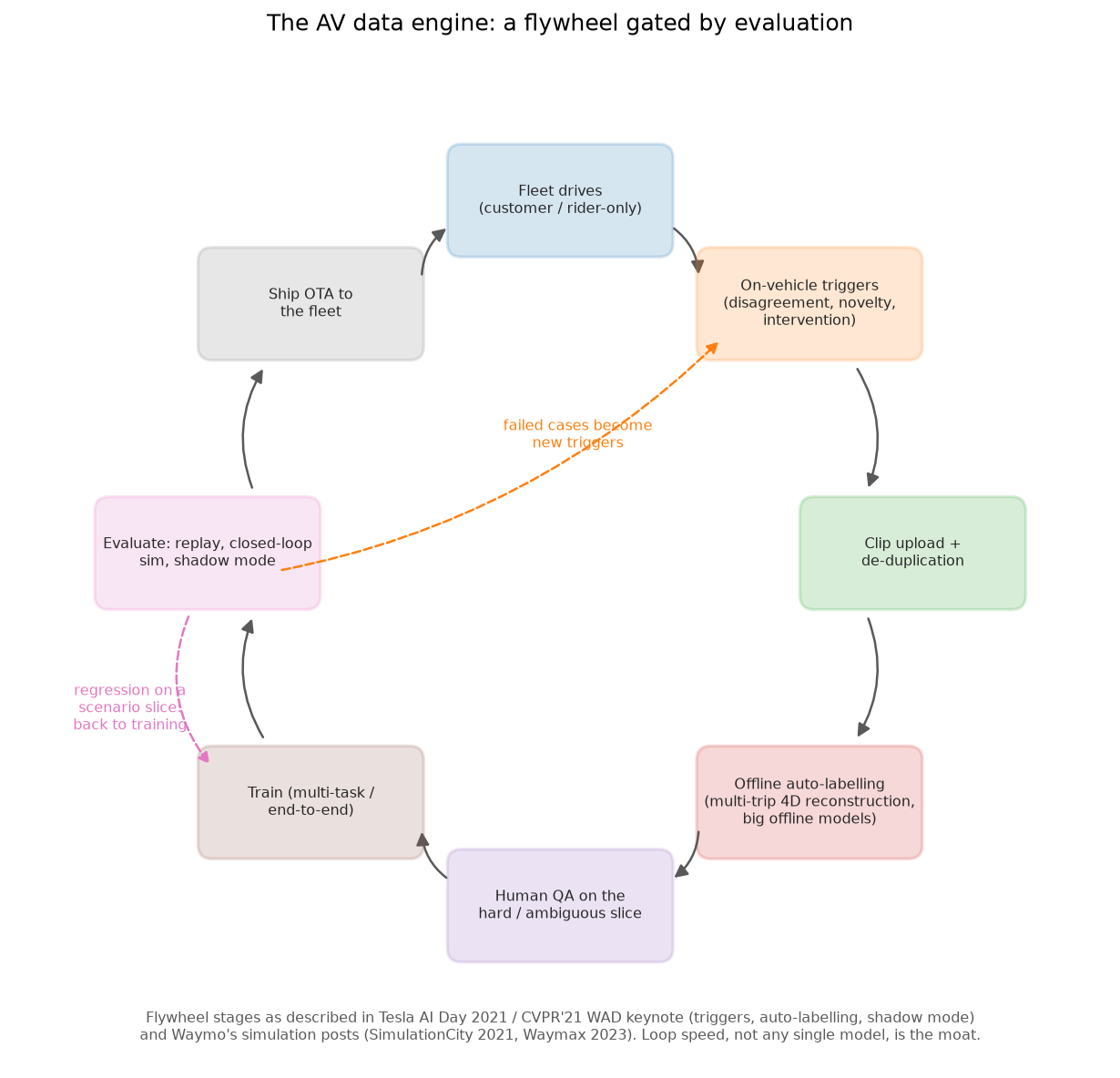
The two dashed arrows are the part that decides iteration speed: evaluation results feed back into both the trigger library and the training set, so a failure found in shadow mode becomes a collection campaign rather than a bug report.
The trade-off. A large, slow offline model plus reconstruction gives labels no annotator could draw (dense geometry, kinematics across occlusion) and a marginal cost per clip that falls with automation; the price is systematic errors that propagate silently (a bias in the reconstruction becomes a bias in every label), which is why the human review is concentrated on the disagreement slice. The rejected alternative, vendor-labelled 2D boxes at scale, cannot supervise a BEV/occupancy model at all.
Sources. Karpathy, CVPR'21 WAD keynote; Tesla AI Day 2021 (data engine, auto-labelling, simulation); Tesla AI Day 2022 (auto-labelling for lanes, data engine example).
How to say it in the interview
"I'd treat the fleet as a sampler and the offline labeller as the teacher. On the car I'd run a small library of triggers, model disagreement, driver intervention, head-versus-head inconsistency, and novelty, and upload only the clips that fire; Tesla's CVPR'21 WAD keynote and AI Day 2021 describe exactly this trigger catalogue, and it's the only way to keep upload bandwidth proportional to information rather than to miles. Offline, I'd reconstruct multi-trip clips into a single 4D scene and derive labels for every frame from it, as AI Day 2021 and 2022 show for lanes and moving objects, and I'd spend human time reviewing auto-labels on the disagreement slice instead of drawing boxes. The alternative I'd pass on is sampling miles uniformly and paying a vendor for 2D boxes: uniform sampling never sees the tail, and 2D boxes can't supervise a BEV model. The risk I'd name is correlated label error from the reconstruction, so I'd hold out a small human-labelled gold set per scenario and gate every labeller change on it. I'd measure the engine by time-from-trigger-to-deployed-fix on a named scenario, not by label volume."
3.4 Lanes as language, planning as search, and the move to end-to-end¶
The problem. Without HD maps the car must infer lane topology live, including connectivity through an intersection that no pixel shows. Then it must choose a trajectory among agents that react to it.
The approach. AI Day 2022 presents the lane network as an autoregressive decoder: the lane graph is emitted as a sequence of tokens (points, geometric primitives, connectivity), attending to the BEV features and to coarse map hints, in the same way a language model emits words. This is the set-prediction / DETR idea applied to a graph: decoding tokens sequentially lets the model express topology that a segmentation mask cannot. The same event describes the planner as interaction search: neural networks propose candidate trajectories and score them, including estimates of how other agents respond, while the search handles the combinatorics; the scoring uses signals such as collision checks against the occupancy volume, comfort, and a learned estimate of intervention likelihood. Then the Q4 2023 shareholder update describes FSD V12 as end-to-end: a network from video to control, which the public materials frame as replacing the hand-written planning code. What is not public: the architecture, whether the 2022 heads remain as auxiliary losses, or how the training set of human driving is curated.
The trade-off. Learned topology and learned planning remove hand-written interfaces that were the source of brittleness, at the cost of interpretability and of an evaluation problem: an end-to-end policy can only be judged by driving outcomes, so the evaluation stack (replay, closed-loop simulation, shadow mode, scenario slices) becomes the product. The rejected alternative is the modular stack with a rule-based planner; its strength (auditable decisions) is exactly what the safety argument in the Waymo chapter leans on, which is why the two companies diverged. The mathematics of imitation and its failure modes (compounding error, causal confusion) are in Imitation learning and Prediction & planning.
Sources. Tesla AI Day 2022 (lanes, planning); Tesla Q4 2023 Update letter (V12 framed as end-to-end).
How to say it in the interview
"If the product can't rely on HD maps, I'd decode the lane graph as a token sequence, the way Tesla's AI Day 2022 lanes talk does, because topology through an intersection is a graph-structured output that a mask can't express. For planning I'd start with a learned proposal-and-scoring planner inside an explicit search, again as AI Day 2022 describes, before moving to end-to-end control; the search gives me an auditable decision and a place to put hard constraints while the learned parts absorb the human-likeness. I'd say plainly that Tesla's Q4 2023 letter describes V12 as end-to-end, but that the architecture isn't public, so I wouldn't claim to know how the modular heads are used. The call I'd commit to is this. The modular planner buys interpretability and a place to enforce hard constraints. Hand-written interfaces cap how human-like the driving can get. Which of those dominates depends on how close the product is to removing the driver. I'd evaluate any planner change with closed-loop replay on scenario slices and shadow-mode disagreement against the shipped policy, and I'd treat intervention rate as the north-star metric while tracking its exposure mix."
3.5 Dojo and training infrastructure: why build a chip, and when not to¶
The problem. Training on fleet video is bound by I/O, memory bandwidth and interconnect as much as by FLOPs; the data loader, video decoding and all-reduce dominate at scale.
The approach. AI Day 2021 introduced the D1 chip and a "training tile" of 25 D1 dies with a wafer-scale-style interconnect and its own power/cooling, quoting 362 TFLOPS (BF16/CFP8) per chip and 9 PFLOPS per tile; the Hot Chips 34 talks describe the microarchitecture (a mesh of general-purpose cores with large local SRAM and vector / matrix units, rather than a classical systolic array), the Dojo Interface Processor that bridges host memory, and the Tesla Transport Protocol used across the fabric; the Dojo technology whitepaper defines the configurable CFloat8/CFloat16 formats. The roofline reasoning that motivates such a design (which operations are bandwidth- bound, how much SRAM near compute buys you) is derived in Hardware, memory & roofline; the parallelism vocabulary (data, tensor, pipeline; why interconnect topology matters) is in Distributed training.
The trade-off, and the epilogue. A custom chip trades the mature software stack, supply and kernel ecosystem of GPUs for a fabric and memory hierarchy tailored to one workload. Press reports in August 2025 said Tesla disbanded the Dojo team and would concentrate on its in-car inference chips and on bought GPU capacity; Tesla has not published a technical retrospective, so treat the outcome as reported and the analysis as the durable lesson: build silicon only when your workload's bottleneck is one that commodity hardware will not fix on your timeline, and you can staff the compiler.
Sources. Tesla AI Day 2021 (Dojo section); Hot Chips 34, "The Microarchitecture of Tesla's Exa-Scale Computer" and "Super-Compute System Scaling for ML Training"; Tesla, "Tesla Dojo Technology" whitepaper (CFloat8).
How to say it in the interview
"Before proposing custom silicon I'd write down the roofline for the actual workload: video decode, augmentation, and multi-camera batching are I/O- and bandwidth-bound, and at fleet scale the interconnect and data loader dominate. Tesla's AI Day 2021 Dojo section and the Hot Chips 34 talks describe a design that attacks exactly that, large SRAM near compute, a mesh fabric and a custom transport protocol, and their CFloat8 whitepaper shows they were willing to change numerics for throughput. My default decision, though, would be GPUs with a well-engineered video pipeline, because the software ecosystem and kernels are where most of the speedup lives, and I'd reserve custom hardware for a bottleneck that vendors won't fix in time. I'd note that press reports in 2025 describe Dojo being wound down. There's no public post-mortem, so I'd stop at the trade-off. I'd measure the infrastructure by model-FLOP utilisation and by samples per second end-to-end from storage, not by peak TFLOPS."
3.6 Optimus: the same stack, a different body¶
The problem. A humanoid needs perception that generalises across household and factory scenes and a control policy for which no fleet data exists.
The approach (public). AI Day 2022 presented the first Optimus prototype and stated that it runs the FSD computer and reuses the vision stack (occupancy-style scene understanding, the same training infrastructure); the Gen 2 video (December 2023) showed improved actuators and hands; the "We, Robot" event (October 2024) showed robots interacting with guests, and reporting at the time indicated teleoperation was involved in parts of the demonstration. The public ML narrative is imitation from human demonstration and teleoperation, i.e. the behaviour-cloning setting in Imitation learning, with the data-engine reflexes of §3.3 applied to a fleet of robots rather than cars. Anything more specific about Optimus's policy architecture is not public; the industry reference points for the class of model are NVIDIA's GR00T N1 (see the NVIDIA chapter) and DeepMind's Gemini Robotics.
The trade-off. Sharing the car's vision stack buys mature perception and tooling; the cost is that manipulation needs contact-rich, high-rate control data that cars never produced, so the bottleneck moves to demonstration collection and to sim-to-real.
How to say it in the interview
"For a humanoid programme I'd reuse the vehicle perception stack and training infrastructure, as Tesla said it did at AI Day 2022, and put the new investment into demonstration data: teleoperation rigs, a data engine that triggers on policy failures, and simulation for the contact-rich skills. I'd start with behaviour cloning on demonstrations because it's the fastest way to a policy that does anything, and I'd be explicit about its failure mode, compounding error away from the demonstration distribution, which is why I'd add on-policy data collection with human correction. The alternative I'd reject at the start is reinforcement learning from scratch on hardware; the sample cost is prohibitive without a good prior. I'd evaluate with task success rate under distribution shift (new objects, new lighting) and intervention rate per hour, and I'd state that Tesla has not published the policy architecture, so my design would draw on the public GR00T N1 and Gemini Robotics reports for the model class."
4. Likely interview questions¶
Q1. Design the perception system for a camera-only car: eight cameras, no lidar, no HD map, a fixed inference budget.
Answer sketch. Requirements first: outputs the planner needs (occupancy + flow, lane graph, agents with tracks, traffic controls), latency budget per frame, and calibration variance across the fleet. Architecture: rectify cameras to a virtual camera; shared per-camera backbone; cross-attention view transform to a BEV grid; temporal memory; multi-task heads sharing the backbone (HydraNet-style) so new outputs do not multiply inference cost. Supervision: offline 4D auto-labels; human review on the disagreement slice. Evaluation: range-binned BEV metrics, seam and occlusion slices, and downstream planner metrics in replay. Trade-off named: interpretability of explicit depth (LSS) versus flexibility of attention. Cross-links: Multi-camera & BEV, AV perception design.
How to say it in the interview
"I'd decide on a single BEV feature grid built by cross-attention from all eight cameras, with multi-task heads on top, because Tesla's AI Day 2021 perception talk shows that per-camera detection fails at seams and that a shared backbone with many heads is how you fit a growing output list into a fixed in-car budget. I'd reject explicit per-pixel depth as the primary route; Lift-Splat-Shoot-style depth is more interpretable, but it commits to a depth bin early and the attention route lets context resolve ambiguity. The price is supervision: BEV outputs need 3D labels, so I'd pair the model with an offline auto-labelling pipeline. I'd gate releases on range-stratified BEV AP, an occlusion-recall slice for the temporal module, and closed-loop replay of planner behaviour, and I'd track calibration drift as a first-class monitoring signal."
Q2. Why did Tesla move from 3D boxes to occupancy, and what does the planner lose?
Answer sketch. Boxes require a class vocabulary and a shape prior; occupancy is class-agnostic geometry with flow. The planner gains a collision-checkable volume for anything; it loses instance identity and cheap long-range reasoning, so a tracking head stays for interacting agents. Costs: cubic memory, coarse far-field resolution, supervision from reconstruction. Staff follow-up: how would you compress the volume (sparse voxels, octrees, implicit decoders queried only along the planned trajectory)?
How to say it in the interview
"I'd explain the move as a representational fix: the CVPR'22 WAD keynote argues that the objects that hurt you have no class, so the primary output became a volumetric occupancy and flow grid. I'd keep boxes and tracks for agents whose intent matters, because occupancy has no identity. The cost I would name is memory: the grid grows cubically, so I'd go sparse or use an implicit decoder queried only where the planner needs it. I'd evaluate with voxel IoU by distance and with the planner's collision rate on an unknown-object slice."
Q3. Design the fleet trigger and upload system: what fires, what is uploaded, and how you keep it from drowning you.
Answer sketch. Triggers: model–driver disagreement, interventions, head inconsistency, novelty scores, scenario detectors, targeted campaigns. Budget: per-car upload caps, priority queues, on-car de-duplication (embedding similarity), server-side de-duplication, and a feedback signal from the labeller ("this clip changed a label") to re-weight triggers. Privacy and bandwidth constraints named. Evaluation: fraction of uploaded clips that produced a label change or a training gain, and time-to-fix per scenario.
How to say it in the interview
"I'd build a trigger library on the car and treat uploads as a budgeted priority queue; Tesla's CVPR'21 WAD keynote and AI Day 2021 describe a catalogue of triggers and campaigns, and I'd add embedding-based de-duplication on both ends so a common scenario can't dominate. The alternative, uniform sampling of miles, never reaches the tail. The trade-off is bias: trigger-selected data isn't the driving distribution, so I'd keep a small uniformly sampled stream for calibration and evaluation. I'd measure the system by the yield of uploaded clips, the share that changed a label or moved a metric, and by time from trigger to deployed fix."
Q4. You have millions of clips and a BEV model to supervise. Design the auto-labelling pipeline and its quality control.
Answer sketch. Offline multi-trip reconstruction: ego-trajectory optimisation, multi-camera geometry, large offline models with no latency budget, NeRF-style densification for surfaces; derive lanes, static and moving objects, kinematics; project to every frame. QC: gold sets per scenario, agreement between independent labellers (model versus reconstruction versus human), consistency checks across trips, and human review targeted at disagreement. Failure mode: correlated errors. Link: Weak supervision & auto-labelling.
How to say it in the interview
"I'd reconstruct the scene once from every trip through it and project labels back to each frame, because AI Day 2021 and 2022 show that a 4D offline reconstruction gives geometry and kinematics no annotator can draw. I'd reject per-frame human 3D annotation as the primary source; it's too slow and inconsistent across frames. The trade-off is correlated error, so I'd hold gold sets per scenario, run consistency checks across trips, and route human time to disagreement. My acceptance metric is downstream: does the retrained model improve on the held-out gold slice without regressing others."
Q5. FSD V12 is described as end-to-end. How would you evaluate and safely ship a new end-to-end policy?
Answer sketch. Three layers: open-loop replay (cheap, biased), closed-loop simulation with reactive agents (needed for compounding error), and shadow mode on the fleet (real distribution, no control authority, counterfactual caveats). Metrics: intervention rate by scenario slice, disagreement with the shipped policy, comfort, hard-constraint violations. Staged rollout by geography and driver cohort. Name the counterfactual problem in shadow mode: you do not see what the new policy would have caused. Links: Imitation learning, Evaluation.
How to say it in the interview
"I'd ship an end-to-end policy only through a three-layer evaluation stack: replay for cheap regression, closed-loop simulation for compounding error, and shadow mode on the fleet for the real distribution, which is the loop Tesla's AI Day talks describe. I'd reject relying on open-loop imitation loss; it doesn't predict closed-loop behaviour. The trade-off with end-to-end is the loss of auditable intermediate decisions, so I'd keep hard-constraint checkers outside the policy. I'd gate on intervention rate per scenario slice, not fleet-wide, because a fleet-wide average hides regressions in rare slices, and I'd track the exposure mix."
Q6. Explain shadow mode. What can it tell you and what can it not?
Answer sketch. A candidate model runs on the car without control authority; its outputs are compared with the shipped model and with the driver. It gives real distribution, cheap scale, and disagreement clips for the data engine. It cannot give closed-loop outcomes (the world does not react to the candidate), so it over-estimates safety in interactive scenarios and under-samples what the candidate would have encountered. Combine with closed-loop simulation.
How to say it in the interview
"Shadow mode is how I'd get real-world disagreement at scale without risk, as Tesla's AI Day 2021 data-engine section describes, but I'd be explicit that it's open-loop: the world never reacts to the candidate, so it can't measure compounding behaviour. I'd use it to mine disagreement clips and to bound regression, and I'd pair it with closed-loop simulation for interactive scenarios. Simulation costs money and realism; I would evaluate the pairing by whether simulation disagreement predicts shadow-mode disagreement on the same slices."
Q7. How do you get metric depth from cameras alone, and how would you validate it in the fleet?
Answer sketch. Multi-view geometry across cameras with overlap plus temporal parallax from ego-motion give scale; self-supervised photometric losses give dense depth without labels; the BEV transform can absorb depth implicitly. Validation: offline reconstruction as ground truth, radar-era data where available, range slices. Link: Geometry & cameras, 3D perception.
How to say it in the interview
"I'd get scale from ego-motion and the overlapping cameras, and I'd let the BEV transform learn depth implicitly rather than regress it per pixel, following the direction of Tesla's AI Day 2021 fusion design and Karpathy's CVPR'21 argument that vision could replace radar for range. I'd reject a monocular depth head as the sole source because scale is ambiguous. I'd validate against offline reconstruction, sliced by range and by weather, and I'd keep a radar-comparison slice from cars that still had radar as a sanity check on far-range bias."
Q8. Latency: the car runs one FSD computer. How do you fit occupancy, lanes, agents and planning?
Answer sketch. Shared backbone and neck; heads batched; INT8 quantization with per-channel scales and calibration on fleet data; resolution tiering (near-field fine, far-field coarse); run heavy heads at lower rates; profile with a roofline to find bandwidth-bound layers. Link: Quantization, Hardware, memory & roofline.
How to say it in the interview
"I'd share one backbone across every task, the HydraNet pattern from AI Day 2021, and spend the budget on heads, because backbone FLOPs dominate. Then I'd quantize to INT8 with fleet-data calibration, tier resolution by range, and run slow-changing heads like lanes at a lower rate. I'd reject separate per-task networks; they multiply cost. I'd profile with a roofline to find memory-bound layers, and I'd gate on p99 latency at thermal limits, not on mean latency."
Q9. Would you build a training chip? Argue from Dojo.
Answer sketch. Roofline the workload; identify whether the bottleneck is compute, memory bandwidth, interconnect, or the data pipeline; estimate the software cost (compiler, kernels); compare with buying GPUs on the same timeline. Dojo's public design (large local SRAM, mesh fabric, custom transport, CFloat8) targets video-training bottlenecks. Reported outcome in 2025. Decision rule: build only when the bottleneck is one vendors will not fix in time and you can staff the compiler.
How to say it in the interview
"My default would be no: buy GPUs and engineer the video pipeline, because most of the speedup at this scale is in kernels, data loading and parallelism strategy. I'd justify that against Dojo's own public design: the Hot Chips 34 talks show it attacking real bottlenecks, SRAM near compute, a mesh fabric, and a custom transport protocol, and the CFloat8 whitepaper shows how far they went on numerics, but press reports in 2025 describe the programme being wound down and there's no public post-mortem. The trade-off is ecosystem versus fit. I'd measure by end-to-end samples per second and model-FLOP utilisation, and I'd revisit only if a vendor roadmap could not meet a bottleneck I could quantify."
Q10. Coding: implement a camera-to-BEV feature projection and explain the shapes.
Answer sketch. Given per-camera features \(F \in \R^{N_{cam} \times C \times H \times W}\), intrinsics \(K\), extrinsics \([R|t]\), and a BEV grid of \(X \times Y\) cells at fixed heights, project each cell's 3D points into each camera, sample features (bilinear), mask out-of-frustum points, and reduce across cameras (mean, or attention weights). Shape comments on every line; test with a synthetic scene where the answer is known. Reference implementation: the view-transform code in Multi-camera & BEV.
How to say it in the interview
"I'd write the geometric version first, sampling image features at the projection of each BEV cell's 3D anchors, because it's testable against a synthetic scene, and then explain how Tesla's AI Day 2021 design replaces the fixed projection with learned attention. I'd reject writing the attention version first; it's harder to unit test. I'm trading flexibility against verifiability, and I'd test both with a scene where a single object should land in a known cell from two cameras."
Q11. The long tail: how do you know your coverage is improving, not just your average metrics?
Answer sketch. Define scenario taxonomy; track per-slice metrics and slice sizes; use novelty triggers to grow the taxonomy; use simulation to synthesise rare cases (AI Day 2021/2022 simulation sections); report worst-slice rather than mean. Guard against slice hacking with a frozen uniformly sampled evaluation stream. Link: Evaluation.
How to say it in the interview
"I'd define a scenario taxonomy and make the release metric the worst slice, not the mean, and I'd let novelty triggers propose new slices, which is the data-engine loop from Tesla's AI Day 2021. For slices too rare to collect I'd synthesise them, as the AI Day simulation sections describe, while keeping a frozen uniformly sampled stream so I can't fool myself. I would reject a single fleet-wide safety number as the gate because it hides regressions in rare slices."
Q12. Why decode the lane graph as a token sequence rather than a segmentation mask?
Answer sketch. Lanes are a graph with topology and connectivity through occluded regions; masks give geometry without connectivity and need brittle post-processing. Autoregressive decoding expresses topology natively and can condition on coarse map hints. Costs: sequential latency and exposure bias; evaluate with graph-level metrics (connectivity precision/recall), not pixel IoU. Link: DETR & set prediction.
How to say it in the interview
"I'd decode lanes as a token sequence, as Tesla's AI Day 2022 lanes talk does, because the planner needs connectivity and a mask can't express it. I would reject mask plus post-processing; it breaks at intersections. The trade-off is sequential latency and exposure bias, so I'd cap sequence length by range and evaluate with connectivity precision and recall against auto-labelled graphs, not pixel IoU."
Q13. Tesla publishes a Vehicle Safety Report comparing Autopilot miles to non-Autopilot miles. Critique it as an evaluation.
Answer sketch. Exposure bias (Autopilot is used disproportionately on highways, the safest miles); selection bias in who engages it; different crash definitions from national statistics; no rider-only comparison. A better design: scenario-matched or road-type-matched comparison with confidence intervals, as in the Waymo human-benchmark studies. Link: Statistics.
How to say it in the interview
"I'd say the report is a ratio of crashes per mile with and without Autopilot, and that the comparison is confounded by where Autopilot is used; highway miles are the safest miles. I'd propose matching on road type and conditions and reporting confidence intervals, which is the design Waymo's peer-reviewed benchmark comparisons use. The price is that a matched analysis needs exposure data Tesla doesn't publish."
Q14. Optimus: design the data pipeline for a manipulation policy in a factory.
Answer sketch. Teleoperation rigs for demonstrations; automatic segmentation of demonstrations into skills; behaviour cloning with a diffusion or transformer policy; on-policy corrections (DAgger-style); simulation for contact-rich pretraining; a trigger library on the robot for failures; evaluation by task success under shift. Link: Imitation learning.
How to say it in the interview
"I'd start with teleoperated demonstrations and behaviour cloning, because Tesla said at AI Day 2022 that Optimus reuses the FSD perception and infrastructure, so the missing piece is control data, and I'd add on-policy corrections to fight compounding error. I'd reject RL from scratch on hardware. I'd evaluate by success rate on held-out objects and by interventions per hour, and I'd cite GR00T N1 and Gemini Robotics as the public reference points for the policy class, since Tesla's isn't published."
5. What to bring from your background¶
- Large-scale detection and OCR map directly onto the data engine: you have run labelling pipelines, measured label noise, and built active-learning loops. Frame that experience in Tesla's vocabulary (triggers, auto-labels, gold sets, worst-slice metrics) and be ready to quantify yield: what fraction of collected data changed a metric.
- Multi-view geometry and calibration experience is the direct prerequisite for the BEV and occupancy discussions; be able to derive the view transform and say where calibration error shows up in BEV metrics.
- Inference optimisation (quantization, multi-task sharing, latency at thermal limits) is a first-class topic because of the fixed in-car budget; bring a concrete story about fitting a model into a budget without losing a slice.
- ML-systems experience (data loaders, distributed training, evaluation infrastructure) matters more than novel architectures; Tesla's public materials spend as much time on infrastructure as on models.
- Evaluation design for safety-critical systems: scenario slicing, shadow mode caveats, matched comparisons. If you have shipped an OCR or detection model under a strict regression gate, that is the story to tell.
6. Sources¶
Talks and events
- Tesla AI Day 2021. youtube.com/watch?v=j0z4FweCy4M
- Tesla AI Day 2022. youtube.com/watch?v=ODSJsviD_SU
- Tesla Autonomy Day 2019. youtube.com/watch?v=Ucp0TTmvqOE
- Andrej Karpathy, CVPR 2021 Workshop on Autonomous Driving keynote. youtube.com/watch?v=g6bOwQdCJrc
- Ashok Elluswamy, CVPR 2022 Workshop on Autonomous Driving keynote (occupancy networks). youtube.com/watch?v=jPCV4GKX9Dw
- Tesla Optimus Gen 2 video (December 2023). youtube.com/watch?v=cpraXaw7dyc
- "We, Robot" event (October 2024): Tesla livestream; cited by name (URL not verified).
Hardware and infrastructure
- Hot Chips 34 (2022), "The Microarchitecture of Tesla's Exa-Scale Computer". PDF
- Hot Chips 34 (2022), "Super-Compute System Scaling for ML Training" (Dojo system). PDF
- Tesla, "Tesla Dojo Technology" (CFloat8/CFloat16 formats). PDF
Company documents
- Tesla AI & Robotics page. tesla.com/AI
- Tesla Q4 2023 Update (shareholder letter; FSD V12 described as end-to-end). PDF
- Tesla Vehicle Safety Report. tesla.com/VehicleSafetyReport
- Press reports on the Dojo team (August 2025): cited by description; no single primary source.
Technique references used in this chapter
- Philion & Fidler, "Lift, Splat, Shoot" (ECCV 2020). arXiv:2008.05711
- Li et al., "BEVFormer" (ECCV 2022); Tian et al., "Occ3D" (NeurIPS 2023); Hu et al., "Planning-oriented Autonomous Driving (UniAD)" (CVPR 2023). cited by title; see Part XI for the derivations.