Part XII: Reinforcement Learning¶
Why this part exists. Most engineers meet RL backwards: they meet it as "the thing after SFT" in an RLHF diagram, learn the PPO clip formula as an incantation, and then cannot answer why there is a value head at all, or what the advantage is an advantage over. This part builds RL in the order it was actually built (MDP, return, Bellman, dynamic programming, sampling, function approximation, policy gradients), so that when you reach RLHF with PPO, DPO and GRPO in Part VII, every symbol is one you have already derived and coded.
The target: the Bellman equation should feel as natural to you as cross-entropy. You
should be able to write value iteration in ten minutes, explain why a target network
exists in one sentence, derive REINFORCE from the log-derivative trick at a whiteboard,
and say exactly what PPO's min is protecting you from.
The map¶
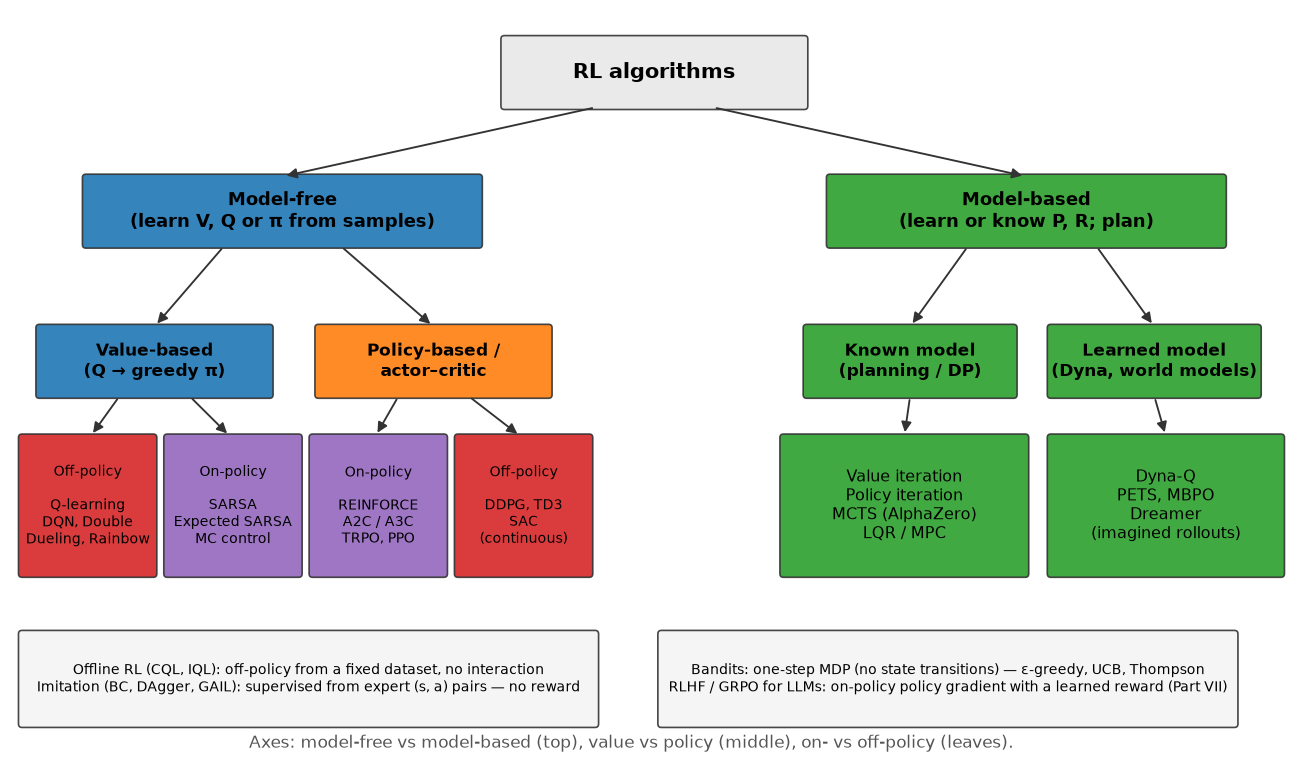
Read the figure top-down as three independent questions an interviewer is really asking when they ask "which algorithm would you use?":
- Do you have a model of the environment? If you know \(P(s'\mid s,a)\) and \(R(s,a)\) (a simulator you can query, a game's rules, a chip floorplan scorer), you can plan: value iteration, policy iteration, MCTS, MPC. If you only have samples, you are model-free. Model-based is far more sample-efficient and far more sensitive to model error; the classic failure is a policy that exploits a bug in your simulator.
- Do you learn a value function or a policy? Value-based methods learn \(Q\) and act greedily; they need a \(\max_a\), so they want discrete actions, and they are naturally off-policy (they can learn from anyone's data, including a replay buffer). Policy-based methods parameterise \(\pi_\theta\) directly; they handle continuous and huge action spaces and stochastic optimal policies, at the cost of being on-policy and sample-hungry. Actor–critic is the useful middle: a policy to act, a value function to cut the variance of its gradient.
- On- or off-policy? On-policy means the data must come from the policy you are updating (REINFORCE, A2C, TRPO, PPO). Off-policy means it need not (Q-learning, DQN, DDPG/TD3/SAC, offline RL). This single axis decides your systems design: off-policy methods get replay buffers and can reuse logs; on-policy methods get rollout workers and throw data away after a few epochs.
Two whole families hang off the edges of the tree and matter enormously in production: bandits (a one-step MDP with no state transitions, which is what most recommender and ads "RL" actually is) and imitation learning (supervised learning from expert actions, which is what most autonomy planners and every LLM SFT stage actually are).
Chapters¶
| # | Chapter | What you will be able to do |
|---|---|---|
| 1 | MDPs & Bellman equations | Define an MDP, derive both Bellman equations, prove the policy improvement theorem, explain why value iteration converges, and say why perception makes autonomy a POMDP. |
| 2 | Classical RL algorithms | Derive UCB from Hoeffding, implement value/policy iteration, MC, TD(0), \(n\)-step, SARSA vs Q-learning, and explain maximisation bias. |
| 3 | Deep RL & DQN | Derive the DQN loss, explain replay and target networks as fixes for the deadly triad, and place Double/Dueling/PER/Rainbow/distributional RL. |
| 4 | Policy gradients, GAE & PPO | Derive REINFORCE and the baseline identity, build GAE as exponentially weighted \(n\)-step advantages, and derive PPO's clipped objective and its gradient. |
| 5 | Imitation learning | Explain BC's \(O(T^2)\) compounding error, implement DAgger, and connect SFT-is-BC to why RLHF exists. |
| 6 | Agents & tool use | Frame an LLM agent as an MDP, build the observe–reason–act loop, and reason about evaluation, multi-agent systems and reliability. |
Prerequisites¶
You do not need Parts IV–XI to read this part. You do need:
- Probability: expectation, conditional expectation, variance, the law of total expectation, and Beta/Bernoulli conjugacy for Thompson sampling: Part I, Probability.
- Optimization: SGD, Adam, gradient clipping, learning-rate schedules: Part I, Optimization.
- Neural nets and autograd: MLPs, backprop, and what
.detach()does: Part III. Chapters 3–6 use PyTorch; chapters 1–2 are pure NumPy and need nothing but linear algebra. - Information theory: KL divergence and entropy, for the entropy bonus, KL early-stopping and MaxEnt IRL: Part I, Information theory.
Everything else is built here. The environments are implemented from scratch in
src/mlbook/rl/envs.py (no gym), so every number in this part is reproducible with
numpy, torch and 30 seconds of CPU.
Where this part is used elsewhere¶
flowchart LR
  A[XII.1 MDP & Bellman] --> B[XII.2 Classical RL]
  B --> C[XII.3 Deep RL & DQN]
  B --> D[XII.4 Policy gradients, GAE & PPO]
  A --> E[XII.5 Imitation learning]
  D --> F[VII.3 RLHF with PPO]
  D --> G[VII.5 Reasoning RL & GRPO]
  E --> H[VII.1 SFT]
  D --> I[XII.6 Agents & tool use]
  A --> J[XI.6 Prediction & planning]
  E --> J
  B --> K[XVII.1 Feed & recommendation ranking]
Part VII assumes chapter 4. When it writes \(\hat{A}_t\), the ratio \(r_t(\theta)\), the clipped objective and the KL penalty, it is pointing at derivations that live here. Part XI's planner chapter assumes chapter 5. Part XVII's ranking chapter assumes the bandit material in chapter 2.
The "one day" ordering¶
If you have a single day before an RL-heavy interview, read in this order and skip everything else. The times are for reading plus re-deriving on paper, not for writing code.
| Slot | Read | Why it is on the critical path |
|---|---|---|
| 60 min | Ch. 1 §1–§2 through the Bellman optimality equation | Everything else is an approximation to this. Interviewers start here to calibrate you. |
| 30 min | Ch. 1 §2 policy improvement theorem + contraction sketch | The "why does this converge" question, asked at staff level. |
| 45 min | Ch. 2 §2 bandits (UCB derivation, Thompson) | The single most likely production RL question outside a lab. |
| 30 min | Ch. 2 §2 TD error, bias/variance vs MC; SARSA vs Q-learning | The most common whiteboard question in the classical block. |
| 45 min | Ch. 3 §2 DQN loss, replay, target network, deadly triad | The "deep RL is unstable, why?" question. |
| 90 min | Ch. 4 §2 all of it: REINFORCE → baseline → GAE → PPO clip | This is the chapter that pays for RLHF, GRPO and every agent question. |
| 30 min | Ch. 4 §5 the RLHF mapping table | Lets you answer LLM-RL questions without re-deriving anything. |
| 30 min | Ch. 5 §2 the \(O(T^2)\) argument + DAgger | Autonomy interviews and "why not just SFT?" |
| 20 min | Every chapter's TL;DR, the interview card | Last pass, on the train. |
Then, if you have an evening: type value_iteration, q_learning, compute_gae and
ppo_clip_loss from memory and run the tests. Each chapter's Retype by hand section
tells you exactly which symbols to reproduce and what to run.
Running the code¶
pip install -e .
pytest tests/test_rl_*.py -q   # all of Part XII's implementations
python figures/part12_gridworld_values.py   # regenerate any figure
All modules live under src/mlbook/rl/: envs.py, bandits.py,
dynamic_programming.py, mc_td.py, q_learning.py, dqn.py, reinforce.py,
actor_critic.py, gae.py, ppo.py, behavioral_cloning.py, dagger.py,
agent_loop.py.