Part XI. Perception and autonomy
This part is about the stack that turns photons into a steering command, and about the research that is currently dissolving the boundaries inside that stack. If you interview at Tesla, Waymo, Zoox, Nuro, Aurora, NVIDIA, Cruise, Wayve, Figure or a robotics lab, the material here is the difference between an engineer who has trained detectors and an engineer who can own a perception system.
The assumption throughout is that you already know object detection and segmentation (Part IV, Part IV) and the Transformer (Part V). Everything here goes past the single image: multiple calibrated cameras, time, other sensors, other agents, and the future.
The stack you are expected to be able to draw
flowchart TB
  subgraph S["Sensors"]
    C["8 cameras, 30-60 Hz<br/>rolling shutter"]
    L["LiDAR, 10-20 Hz<br/>spinning or solid state"]
    R["Radar, 13-20 Hz<br/>Doppler, sparse"]
    I["IMU + wheel odometry, 100-400 Hz"]
  end
  subgraph P["Perception"]
    CAL["Calibration + time sync<br/>ego-motion compensation"]
    BEV["Shared BEV / vector space<br/>LSS, BEVFormer, BEVFusion"]
    DET["3D detection + segmentation"]
    OCC["Occupancy + flow"]
    TRK["Tracking, association, IDs"]
    MAP["Online mapping, lanes, traffic control"]
  end
  subgraph PR["Prediction"]
    PRED["Multimodal agent futures<br/>p(tau | scene)"]
  end
  subgraph PL["Planning + control"]
    BEH["Behaviour selection"]
    TRAJ["Trajectory optimisation / scoring"]
    CTRL["Controller, 100 Hz"]
  end
  C --> CAL
  L --> CAL
  R --> CAL
  I --> CAL
  CAL --> BEV
  BEV --> DET
  BEV --> OCC
  BEV --> MAP
  DET --> TRK
  TRK --> PRED
  OCC --> TRAJ
  MAP --> PRED
  PRED --> BEH
  BEH --> TRAJ
  TRAJ --> CTRL
  CTRL -->|actuation| S
The modular stack above has one property that keeps it alive in production: every arrow is an interface you can log, replay, unit test and assign to a team. It has one property that keeps people trying to replace it: every interface is lossy. A box with a class label throws away the shape of the thing it boxed. A tracked object throws away the pixels that would have told you the driver is looking at their phone. Errors compound left to right, and the modules are optimised against proxy losses that nobody can prove correlate with "the car drove well".
The end-to-end alternative removes the interfaces:
flowchart LR
  A["Raw multi-camera video<br/>+ ego state + navigation goal"] --> B["Learned encoder<br/>BEV / tokens / latents"]
  B --> C["Policy<br/>imitation + RL + scoring"]
  C --> D["Trajectory or control"]
  B -.->|auxiliary heads kept for<br/>supervision and debugging| E["Detection, occupancy,<br/>language commentary"]
UniAD and VAD keep the modules but make them differentiable query interfaces so the planning loss reaches perception. Tesla's FSD v12 and Wayve's models push further toward video in, controls out. The dotted line matters: every credible end-to-end system keeps auxiliary perception heads, because a policy you cannot interrogate is a policy you cannot certify or debug.
What each chapter covers
| Chapter | The question it answers | The thing you implement |
|---|---|---|
| 1. Perception foundation models | How did detection, segmentation, depth and OCR converge into prompted models? | Open-vocabulary head, box tokenizer |
| 2. Multi-camera and BEV | How do 6 to 8 images become one metric top-down representation? | Lift-Splat-Shoot, BEV query attention, temporal warping |
| 3. Sensor fusion | Where should camera, LiDAR and radar meet, and what happens when one fails? | Point painting, weighted box fusion, cross-attention fusion |
| 4. Tracking | How do detections become identities that survive occlusion? | Kalman filter, Hungarian, SORT, ByteTrack |
| 5. Occupancy and temporal perception | What do you do about obstacles that have no class? | Occupancy head with ego-motion-aligned memory |
| 6. Prediction and planning | How do you represent a future that is genuinely ambiguous? | Multimodal trajectory head, WTA and anchors, minADE |
| 7. World models | Can you learn a simulator good enough to plan and evaluate inside? | Latent dynamics model, CEM planning |
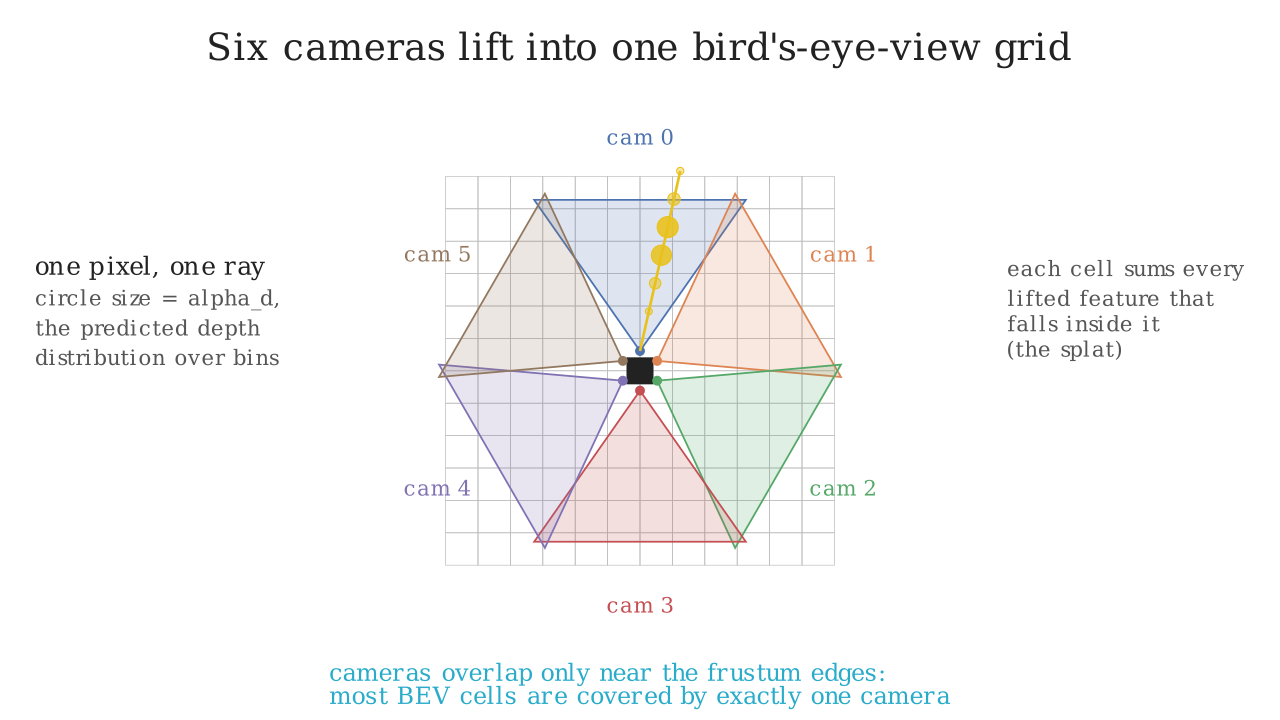
The six camera frusta overlap only near their edges, so most of the BEV plane is covered by exactly one camera. Any error in that camera's extrinsics moves objects in the shared frame with no second view to contradict it, which is the geometric reason calibration drift shows up as a perception problem instead of a calibration alarm.
Prerequisites
Read these first if they are not already fluent:
- Geometry and cameras for intrinsics, extrinsics and
projection. Part XI re-derives the pinhole projection it needs in
src/mlbook/perception/camera_rig.pyso the modules stand alone, but the full treatment of distortion, epipolar geometry and bundle adjustment lives in Part IV. - 3D perception for point clouds, voxels and PointPillars-style encoders.
- Attention mathematics. Every BEV and fusion architecture here is attention with a geometric prior on the keys.
- DETR and set prediction for queries, bipartite matching and the Hungarian algorithm in its detection setting.
- CLIP and contrastive learning for the text embeddings that open-vocabulary detection heads consume.
- Probability for the Gaussian conditioning that the Kalman filter derivation leans on.
Chapter 6 links forward to imitation learning and chapter 7 to policy gradients; you can read Part XI before Part XII and follow the links when you need them.
A one-day ordering
If you have a single day before an autonomy interview, work in this order. The times assume you code along rather than read passively.
- Tracking (chapter 4), 2 hours. It is the most likely coding round in this part. Get to the point where you can write the Kalman predict and update from the model equations and the Hungarian assignment from the cost matrix, without notes.
- Multi-camera and BEV (chapter 2), 2 hours. The most likely ML depth round. Derive Lift-Splat-Shoot on a whiteboard: frustum, depth distribution, outer product, pooling. Then be able to say why BEVFormer inverts the direction and what that buys.
- Prediction and planning (chapter 6), 1.5 hours. Multimodality, the winner-takes-all loss and its failure mode, minADE and minFDE, open-loop versus closed-loop evaluation.
- Occupancy (chapter 5), 1 hour. The long-tail argument, the memory cost, and how temporal fusion works when the ego is moving.
- Sensor fusion (chapter 3), 1 hour. Early, intermediate and late, and the failure and degradation story that senior interviewers push on.
- Foundation models (chapter 1) and world models (chapter 7), 1 hour together. These are your "where is the field going" answers. Skim the TL;DR cards and the production sections.
- The index of Part XVII's AV perception system design, 30 minutes. That chapter is the system design round; this part is the depth behind it.
Each chapter opens with a TL;DR interview card. On the morning of the interview, the cards alone take about twenty minutes to reread.