Tokenization
Why this matters at staff level. "Implement BPE" is a common coding question, and it is one of the few where candidates who have only used
AutoTokenizerare exposed immediately. The design-round version is more interesting: a large fraction of reported LLM failures (arithmetic errors, poor performance in some languages, inability to count letters, bizarre outputs on specific strings) are tokenizer artefacts rather than modelling failures, and knowing which is which saves weeks. Vocabulary size is also a real budget decision that trades embedding parameters against sequence length, and therefore against inference cost.
TL;DR, the interview card
- Characters: tiny vocabulary, no unknown tokens, sequences 4 to 5x longer, so attention costs 16 to 25x more. Words: short sequences, huge vocabulary, unavoidable out-of-vocabulary problem. Subwords sit between and are what every production model uses.
- BPE (Sennrich 2016): start from characters, repeatedly merge the most frequent adjacent pair, record the merge order. Encoding replays merges in learned order. Greedy and deterministic.
- Byte-level BPE (GPT-2): run BPE over UTF-8 bytes instead of characters, with a 256-symbol base
alphabet, so every possible string encodes and there is no
[UNK]token ever. - WordPiece (BERT): same loop, different merge criterion. Pick the pair maximising
\(\frac{\text{count}(ab)}{\text{count}(a)\,\text{count}(b)}\), the pair whose merge most increases
corpus likelihood under a unigram model. Continuation pieces carry
##. - Unigram LM (Kudo 2018): start from a large candidate vocabulary, fit piece probabilities with EM, prune the pieces whose removal costs least likelihood. Segmentation is Viterbi over a lattice, and it can sample alternative segmentations (subword regularisation).
- SentencePiece is the library, not an algorithm. It treats input as a raw stream with no
pre-tokenisation, encodes spaces as
▁so detokenisation is exact, and implements both BPE and Unigram. - Compression ratio (bytes per token) sets sequence length, which sets attention cost, KV cache size, effective context, and price per request. A tokenizer that needs 2x the tokens costs 2x on a linear term and 4x on the quadratic one.
- Multilingual fairness: the same content costs a different number of tokens in different languages, with published measurements showing differences up to 15x. That is a direct cost and latency difference for those users, and a smaller effective context window.
- Number handling: GPT-2 style merges produce inconsistent digit groupings, which is part of why arithmetic is unreliable. Llama splits digits individually; newer tokenizers often group by three.
- Glitch tokens: strings that made it into the vocabulary from the tokenizer corpus but were rare or absent in training data, so their embeddings stayed near initialisation and produce erratic behaviour.
- Vocabulary size trades embedding parameters (\(Vd\)) against sequence length. 32k to 50k was standard for English models; 128k to 256k is common now for multilingual coverage.
1. Intuition first
A language model operates on a finite vocabulary of symbols. Choosing that vocabulary is a compression problem with two competing pressures: fewer symbols per piece of text (shorter sequences, cheaper attention) against more distinct symbols (larger embedding table, more rarely-seen entries).
The two extremes fail in opposite ways.
Characters: about 100 symbols for English, no word is ever unrepresentable, and "unbelievable" is 12
positions. Sequences get 4 to 5x longer than word-level, and since attention is quadratic in length
that is a 16 to 25x cost on the attention term. The model must also spend capacity learning that
c-a-t is a unit.
Words: "unbelievable" is one position. English needs hundreds of thousands of entries to cover a
corpus, the embedding table dominates the parameter count, rare words get poorly-trained embeddings,
and any word not in the vocabulary at training time becomes [UNK] forever. Morphologically rich
languages (Finnish, Turkish, German compounds) make this much worse.
Subword tokenization keeps frequent words whole and splits rare ones into pieces:
"unbelievable"  ->  ["un", "believ", "able"]
"the"           ->  ["the"]
"tokenization"  ->  ["token", "ization"]
"Kolmogorov"    ->  ["Kol", "mog", "orov"]
The split is learned from corpus statistics, not from a morphological analyser, so the pieces are not always linguistically sensible. They are statistically sensible, which is what matters for compression.
BPE learns the vocabulary by repeated merging. Start with every word as a sequence of characters,
count adjacent pairs across the corpus, merge the most frequent, repeat. The classic worked example
from Sennrich's paper, with word frequencies low:5, lower:2, newest:6, widest:3:
| Step | Most frequent pair | Count | New symbol |
|---|---|---|---|
| 1 | (e, s) |
9 | es |
| 2 | (es, t</w>) |
9 | est</w> |
| 3 | (l, o) |
7 | lo |
| 4 | (lo, w) |
7 | low |
After four merges the vocabulary contains est</w> and low, so "lowest", a word that never
appeared in training, encodes as low + est</w>. That generalisation to unseen words is what
subword tokenization buys.
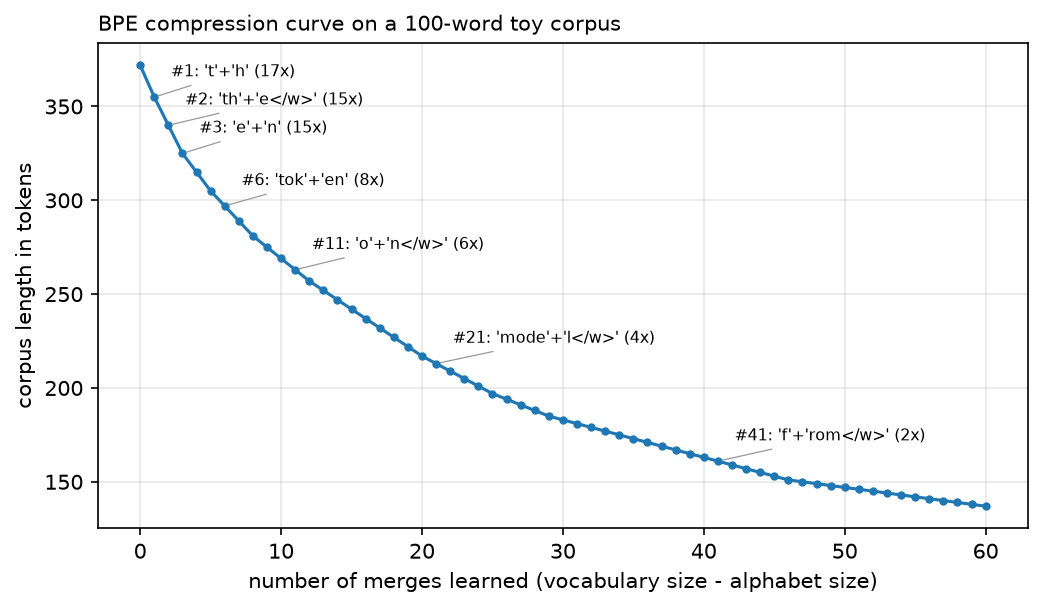
Corpus length in tokens against number of merges, with the merge learned at several points annotated. The first merges are worth the most (they absorb the most frequent pairs) and the curve flattens. Every real tokenizer sits somewhere on the flat part, where an extra thousand vocabulary entries buys a fraction of a percent of compression.
2. The math
2.1 BPE training
Let \(W\) be the multiset of words with frequencies \(f_w\), each represented as a symbol sequence. For symbol sequence \(s\), define the pair count
Each iteration picks \(\argmax_{(a,b)} c(a,b)\), replaces all occurrences with the new symbol \(ab\), appends \((a,b)\) to the ordered merge list, and repeats until the vocabulary reaches the target size.
The greedy objective is corpus length: merging the most frequent pair removes \(c(a,b)\) tokens from the corpus in one step, which is the largest immediate reduction available. This is locally optimal and not globally optimal. Finding the vocabulary of size \(V\) that minimises tokenized corpus length is NP-complete (Kozma and Voderholzer, 2024, prove this for the tokenization problem), so greedy is what everyone uses.
Two implementation details that decide whether your encoder matches your trainer. Ties must be
broken deterministically (we sort by count then lexicographically), or two training runs on the same
corpus produce different vocabularies. And the end-of-word marker (</w>, or a leading ▁) must be
part of the symbol representation from the start, or the tokenizer cannot distinguish "est" inside a
word from "est" ending one.
2.2 BPE encoding
Encoding a new word is not a fresh greedy search. Replay the learned merges in the order they were learned:
Rank order matters because merges were learned in a dependency chain: est</w> only exists because
es was created first. Applying merges by frequency at encode time, or in arbitrary order, produces
segmentations the model never saw.
The naive implementation is \(O(n^2)\) per word (scan for the best pair, apply, repeat). Production
implementations use a priority queue over pair positions with a linked list of symbols, giving
\(O(n\log n)\). tiktoken reports 3 to 6x speedup over comparable open-source tokenizers, which
matters because tokenization sits on the critical path of every request.
2.3 Byte-level BPE
Character-level BPE has an awkward base case: the alphabet must contain every character in the
corpus, which for a multilingual corpus means tens of thousands of entries before any merges, and
any character not seen in training becomes [UNK].
GPT-2 works at the byte level instead. Every string is UTF-8 bytes, there are exactly 256 possible
bytes, so the base vocabulary is 256 and the tokenizer is total: every possible string encodes, no
[UNK] token is needed at all.
One wrinkle. Storing merges as text is convenient, but many byte values are control characters or
whitespace that break text formats. GPT-2 maps the 256 byte values bijectively to 256 printable
Unicode code points, so byte 0x20 (space) becomes Ġ and merges can be stored and read as text.
This is why GPT-2 token dumps are full of Ġ and Ċ: they are space and newline in the
byte-to-Unicode map, not real characters.
GPT-2 also pre-tokenises with a regex before applying BPE, splitting on contractions,
space-prefixed words, digit runs and punctuation. The pre-tokeniser prevents merges from spanning
word boundaries (no single token for "of the"), which bounds vocabulary growth and keeps
segmentation stable. Our PRETOKENIZE regex has the same structure with ASCII classes, since the
original needs the regex module's Unicode property escapes.
2.4 WordPiece
Same merge loop, different scoring. WordPiece picks
The justification: under a unigram language model over the current vocabulary, merging \(a\) and \(b\) into \(ab\) changes the corpus log-likelihood by approximately \(\log p(ab) - \log p(a) - \log p(b)\), which with maximum-likelihood unigram estimates is \(\log\frac{c(ab)/N}{(c(a)/N)(c(b)/N)}\), monotone in the score above. So WordPiece merges the pair whose combination most increases likelihood, while BPE merges the pair that most reduces length.
The difference in practice: BPE favours pairs made of frequent symbols (a frequent pair is usually
made of frequent parts), while WordPiece favours pairs whose parts are unusually likely to occur
together. A pair of rare symbols that always co-occur scores highly under WordPiece and is ignored
by BPE until much later. test_wordpiece_scores_prefer_rare_pairs demonstrates this with a corpus
where zq appears once and aa appears eight times: WordPiece merges zq first, because
\(1/(1\cdot1) > 8/(8\cdot8)\).
WordPiece marks continuations with ##, so "playing" becomes play + ##ing, and encoding uses
greedy longest-match-first from the left. Longest-match is fast and does not need the merge list,
but it can produce a different segmentation than the training-time merge sequence would, and a word
containing any unrepresentable piece becomes [UNK] in its entirety.
2.5 Unigram LM
Unigram inverts the construction. Start with a large candidate vocabulary (all substrings up to some length, pruned by frequency), and treat segmentation as latent:
summing over all segmentations \(S(X)\) of the string. Fit the piece probabilities \(p(s)\) by EM, then prune: for each piece, compute the loss in corpus log-likelihood if it were removed, and drop the bottom fraction. Repeat until the vocabulary reaches the target size. Single characters are never pruned, which guarantees every string remains segmentable.
At encode time, take the most probable segmentation by Viterbi over the lattice:
Two properties distinguish Unigram from BPE. It is probabilistic, so you can sample from the segmentation distribution rather than taking the best one, which is subword regularisation: training on varied segmentations of the same text improves robustness, especially for low-resource languages and noisy input. And it makes a global decision per string instead of applying a fixed greedy merge order, which tends to produce more linguistically plausible pieces.
Unigram is the default in SentencePiece and is used by T5, ALBERT and XLNet. BPE remains more common in decoder-only LMs, largely by inheritance from GPT-2.
2.6 SentencePiece
SentencePiece is a library implementing BPE and Unigram with two design decisions that matter.
No pre-tokenisation. It consumes raw text, including the spaces. Whitespace is escaped as ▁
(U+2581, lower one-eighth block), so "Hello world" becomes ▁Hello ▁world and detokenisation is
exact string concatenation with ▁ replaced by a space. Languages without spaces (Japanese,
Chinese, Thai) need no special handling, because there was never a whitespace assumption.
Language independence. The same code and the same configuration train on any language, which matters because a pre-tokeniser encodes assumptions about the language it was written for.
The practical consequence of exact detokenisation is that decode(encode(x)) == x holds for all
\(x\), which is not true of tokenizers that normalise whitespace or strip accents during
pre-tokenisation. Round-tripping matters for code generation, structured output, and any task where
the model's output is consumed by a parser.
2.7 Special tokens and chat templates
Reserved entries in the vocabulary that mark structure rather than content: [CLS], [SEP],
[MASK], [PAD] in BERT; <|endoftext|> in GPT-2; <s>, </s>, <unk> in Llama. They must
never be producible from user text, or a user can inject them. Byte-level BPE handles this by
keeping them out of the merge process entirely and inserting them only through the encoding API.
Chat models add turn structure with more special tokens
(<|im_start|>, <|im_end|>, or Llama 3's <|start_header_id|>), and the exact sequence of
tokens that wraps a conversation is the chat template. Getting it wrong degrades quality in ways
that look like model problems: a model fine-tuned with one template and prompted with another sees
an input format it has never encountered. Part VII ch. 1 covers
templates and their failure modes.
2.8 Consequences
Compression ratio and cost. Bytes per token determines how many tokens a document costs. English text under a GPT-2-style tokenizer runs about 4 bytes per token. If a tokenizer yields 2x the tokens for the same content, you pay 2x on everything linear in \(T\) (projections, FFN, KV cache, per-token price) and 4x on the attention term, and your effective context window in characters is halved.
Multilingual fairness. Petrov et al. measured tokenized lengths for the same content across languages and found differences up to 15x between language pairs for some tokenizers, persisting in tokenizers explicitly trained for multilingual coverage. For a user of an affected language that is a direct cost multiplier per API call, higher latency, and less content fitting in the context window. The cause is the training corpus: BPE allocates merges in proportion to what it sees, so a corpus that is 90% English produces a vocabulary that compresses English well and everything else badly.
Numbers. GPT-2's merges produce inconsistent digit groupings: a number may split as 12 + 345
or 1 + 2345 depending on which merges happened to be learned, so the same digit occupies
different token positions in different numbers, and the model cannot learn a positional algorithm
for addition. Llama splits every digit into its own token, which is consistent and costs more
tokens. Several newer tokenizers group digits in threes from the right, aligning with how numbers
are written. This is a large part of why arithmetic accuracy varies so much across models with
similar capabilities elsewhere.
Code. Whitespace handling decides how expensive Python is. A tokenizer with no multi-space tokens spends one token per indentation space, so a deeply-indented Python file costs several times more than the same logic in a brace language. GPT-3.5 and later tokenizers added explicit runs of 2, 4, 8, 16 spaces for this reason, and it measurably improves code performance per token of context.
Vocabulary size. The embedding table is \(Vd\) parameters and the output head is another \(Vd\) if untied. At \(d = 4096\), going from 32k to 128k vocabulary adds 393M parameters to the embedding alone. The return is shorter sequences: a larger vocabulary compresses better, especially multilingually. Llama 2 used 32k, Llama 3 uses 128k and reports better compression as the reason. The softmax over \(V\) also costs \(2BTVd\) FLOPs in the head, which becomes noticeable at large \(V\).
Glitch tokens. The tokenizer is trained on one corpus and the model on another (usually larger, differently filtered). A string frequent enough in the tokenizer corpus to earn a vocabulary entry but absent from the training corpus gets an embedding that is never updated from its random initialisation. Feeding it produces behaviour driven by an arbitrary vector: evasion, unrelated output, or repetition. The documented examples from GPT-2 and GPT-3's vocabulary come from Reddit usernames and scraped artefacts that survived into the vocabulary and were then filtered out of training data. The fix is to build the tokenizer from the same distribution as the training data and to audit for tokens with near-zero training frequency.
3. Implementation
3.1 BPE training
def count_pairs(word_freqs: dict[tuple[str, ...], int]) -> Counter:
    """Frequency of every adjacent symbol pair, weighted by how often the word occurs."""
    pairs: Counter = Counter()
    for symbols, freq in word_freqs.items():
        for a, b in zip(symbols, symbols[1:]):
            pairs[(a, b)] += freq
    return pairs

def merge_pair(symbols: tuple[str, ...], pair: Pair) -> tuple[str, ...]:
    """Replace every non-overlapping occurrence of ``pair`` in ``symbols`` by the joined symbol."""
    out: list[str] = []
    i = 0
    while i < len(symbols):
        if i < len(symbols) - 1 and (symbols[i], symbols[i + 1]) == pair:
            out.append(symbols[i] + symbols[i + 1])
            i += 2
        else:
            out.append(symbols[i])
            i += 1
    return tuple(out)

def learn_merges(word_freqs: dict[tuple[str, ...], int], num_merges: int) -> list[Pair]:
    """Greedy BPE training: ``num_merges`` most-frequent-pair merges, in order."""
    merges: list[Pair] = []
    for _ in range(num_merges):
        pairs = count_pairs(word_freqs)
        if not pairs:
            break
        best = max(pairs.items(), key=lambda kv: (kv[1], kv[0]))[0]  # ties broken deterministically
        word_freqs = {merge_pair(w, best): f for w, f in word_freqs.items()}
        merges.append(best)
    return merges
learn_merges is the entire training algorithm in eleven lines. The tie-break
key=lambda kv: (kv[1], kv[0]) sorts by count then by the pair itself, making runs reproducible.
Rebuilding word_freqs each iteration is \(O(\text{corpus})\) per merge, which is fine for a teaching
implementation and is what you would write in an interview. A production trainer maintains an index
from pairs to the words containing them and updates incrementally.
3.2 BPE encoding
def apply_merges(symbols: tuple[str, ...], ranks: dict[Pair, int]) -> tuple[str, ...]:
    """Encode one word: repeatedly merge the present pair with the lowest rank (earliest learned)."""
    while len(symbols) > 1:
        candidates = [(ranks[(a, b)], (a, b)) for a, b in zip(symbols, symbols[1:]) if (a, b) in ranks]
        if not candidates:
            break
        symbols = merge_pair(symbols, min(candidates)[1])
    return symbols
min(candidates) picks the lowest rank, which is the earliest-learned merge present. This is the
line that makes encoding consistent with training, and the most common place to get BPE wrong.
class BPETokenizer:
    """Word-level BPE with an end-of-word marker. ``train`` then ``encode``/``decode``."""

    def __init__(self, end_of_word: str = "</w>", unk_token: str = "<unk>") -> None:
        self.eow = end_of_word
        self.unk = unk_token
        self.merges: list[Pair] = []
        self.ranks: dict[Pair, int] = {}
        self.vocab: dict[str, int] = {}
        self.inv_vocab: dict[int, str] = {}

    def _word_to_symbols(self, word: str) -> tuple[str, ...]:
        return tuple(word[:-1]) + (word[-1] + self.eow,)  # last char carries the marker

    def train(self, corpus: str, vocab_size: int) -> None:
        words = Counter(corpus.split())
        word_freqs = {self._word_to_symbols(w): f for w, f in words.items()}
        chars = {c for w in words for c in w}
        alphabet = [self.unk] + sorted(chars) + sorted(c + self.eow for c in chars)  # every char, with and without the marker
        self.merges = learn_merges(word_freqs, max(0, vocab_size - len(alphabet)))
        self.ranks = {pair: i for i, pair in enumerate(self.merges)}
        tokens = alphabet + [a + b for a, b in self.merges]
        self.vocab = {t: i for i, t in enumerate(tokens)}
        self.inv_vocab = {i: t for t, i in self.vocab.items()}

    def tokenize(self, text: str) -> list[str]:
        out: list[str] = []
        for w in text.split():
            out.extend(apply_merges(self._word_to_symbols(w), self.ranks))
        return out

    def encode(self, text: str) -> list[int]:
        unk = self.vocab[self.unk]
        return [self.vocab.get(t, unk) for t in self.tokenize(text)]  # characters never seen in training -> <unk>

    def decode(self, ids: list[int]) -> str:
        return "".join(self.inv_vocab[i] for i in ids).replace(self.eow, " ").strip()
The alphabet includes each character both bare and with the end-of-word marker, so a single-letter
word or an unseen final character still has a symbol. Characters never seen in training map to
<unk> at encode time, which a character-level BPE cannot avoid.
3.3 Byte-level BPE
def bytes_to_unicode() -> dict[int, str]:
    """GPT-2's reversible map from the 256 byte values to printable unicode characters,
    so that merges can be stored as text and no byte is ever "unknown"."""
    bs = list(range(ord("!"), ord("~") + 1)) + list(range(ord("¡"), ord("¬") + 1)) + list(range(ord("®"), ord("ÿ") + 1))
    cs = bs[:]
    n = 0
    for b in range(256):
        if b not in bs:
            bs.append(b)
            cs.append(256 + n)
            n += 1
    return {b: chr(c) for b, c in zip(bs, cs)}

class ByteLevelBPE:
    """GPT-2 style: pre-tokenise with a regex, map UTF-8 bytes to unicode symbols, BPE over those.
    Base vocabulary is exactly 256 symbols, so any string encodes (no [UNK])."""

    def __init__(self) -> None:
        self.byte_encoder = bytes_to_unicode()
        self.byte_decoder = {c: b for b, c in self.byte_encoder.items()}
        self.merges: list[Pair] = []
        self.ranks: dict[Pair, int] = {}
        self.vocab: dict[str, int] = {}
        self.inv_vocab: dict[int, str] = {}

    def _pretokens(self, text: str) -> list[tuple[str, ...]]:
        chunks = PRETOKENIZE.findall(text)
        return [tuple(self.byte_encoder[b] for b in chunk.encode("utf-8")) for chunk in chunks]

    def train(self, corpus: str, vocab_size: int) -> None:
        word_freqs = Counter(self._pretokens(corpus))
        base = [self.byte_encoder[b] for b in range(256)]
        self.merges = learn_merges(dict(word_freqs), max(0, vocab_size - 256))
        self.ranks = {pair: i for i, pair in enumerate(self.merges)}
        tokens = base + [a + b for a, b in self.merges]
        self.vocab = {t: i for i, t in enumerate(tokens)}
        self.inv_vocab = {i: t for t, i in self.vocab.items()}

    def encode(self, text: str) -> list[int]:
        ids: list[int] = []
        for symbols in self._pretokens(text):
            ids.extend(self.vocab[t] for t in apply_merges(symbols, self.ranks))
        return ids

    def decode(self, ids: list[int]) -> str:
        text = "".join(self.inv_vocab[i] for i in ids)
        return bytes(self.byte_decoder[c] for c in text).decode("utf-8", errors="replace")
bytes_to_unicode builds GPT-2's bijection: printable ASCII and two Latin-1 ranges map to
themselves, and the remaining 68 byte values map to code points starting at 256. The test asserts
it is a bijection on 256 values.
The property worth demonstrating is totality:
for s in ("hello world", "héllo wörld!", "日本語 テキスト", "  spaces  and\ttabs\n", "12345"):
    assert tok.decode(tok.encode(s)) == s
A tokenizer trained only on ASCII English still round-trips Japanese, because every byte has a
symbol. That is test_byte_level_bpe_roundtrips_any_unicode.
3.4 WordPiece
class WordPieceTokenizer:
    def __init__(self, unk_token: str = "[UNK]", prefix: str = "##") -> None:
        self.unk, self.prefix = unk_token, prefix
        self.vocab: dict[str, int] = {}
        self.inv_vocab: dict[int, str] = {}

    def _word_to_symbols(self, word: str) -> tuple[str, ...]:
        return (word[0],) + tuple(self.prefix + c for c in word[1:])

    def _join(self, a: str, b: str) -> str:
        return a + b[len(self.prefix) :] if b.startswith(self.prefix) else a + b

    def train(self, corpus: str, vocab_size: int) -> None:
        word_freqs = {self._word_to_symbols(w): f for w, f in Counter(corpus.split()).items()}
        vocab = [self.unk] + sorted({s for w in word_freqs for s in w})
        while len(vocab) < vocab_size:
            pair_counts: Counter = Counter()
            sym_counts: Counter = Counter()
            for symbols, freq in word_freqs.items():
                for s in symbols:
                    sym_counts[s] += freq
                for a, b in zip(symbols, symbols[1:]):
                    pair_counts[(a, b)] += freq
            if not pair_counts:
                break
            # likelihood-based score: count(ab) / (count(a) count(b))
            best: Pair = max(pair_counts, key=lambda p: (pair_counts[p] / (sym_counts[p[0]] * sym_counts[p[1]]), p))
            new_sym = self._join(*best)
            word_freqs = {tuple(new_sym if s == best[0] + best[1] else s for s in merge_pair(w, best)): f for w, f in word_freqs.items()}
            vocab.append(new_sym)
        self.vocab = {t: i for i, t in enumerate(vocab)}
        self.inv_vocab = {i: t for t, i in self.vocab.items()}

    def tokenize_word(self, word: str) -> list[str]:
        """Greedy longest-match-first from the left; any failure makes the whole word [UNK]."""
        pieces: list[str] = []
        start = 0
        while start < len(word):
            end = len(word)
            piece = None
            while start < end:
                cand = word[start:end] if start == 0 else self.prefix + word[start:end]
                if cand in self.vocab:
                    piece = cand
                    break
                end -= 1
            if piece is None:
                return [self.unk]
            pieces.append(piece)
            start = end
        return pieces

    def tokenize(self, text: str) -> list[str]:
        return [p for w in text.split() for p in self.tokenize_word(w)]

    def encode(self, text: str) -> list[int]:
        return [self.vocab[t] for t in self.tokenize(text)]

    def decode(self, ids: list[int]) -> str:
        out = ""
        for i in ids:
            t = self.inv_vocab[i]
            out += t[len(self.prefix) :] if t.startswith(self.prefix) else (" " if out else "") + t
        return out
The scoring line is the whole difference from BPE:
best: Pair = max(pair_counts, key=lambda p: (pair_counts[p] / (sym_counts[p[0]] * sym_counts[p[1]]), p))
tokenize_word is greedy longest-match: try the longest prefix in the vocabulary, emit it, continue
from there with the ## prefix. Any failure makes the entire word [UNK], which is BERT's
behaviour and differs from BPE, where a word degrades into smaller pieces instead.
3.5 Unigram LM
def viterbi_segment(word: str, log_probs: dict[str, float]) -> tuple[list[str], float]:
    """Most probable segmentation of ``word`` into pieces from ``log_probs``.

    best[i] = max_{j<i, word[j:i] in vocab} best[j] + log p(word[j:i]).  Returns (pieces, log-prob).
    """
    n = len(word)
    best = [-math.inf] * (n + 1)
    back = [0] * (n + 1)
    best[0] = 0.0
    for i in range(1, n + 1):
        for j in range(i):
            piece = word[j:i]
            if piece in log_probs and best[j] + log_probs[piece] > best[i]:
                best[i] = best[j] + log_probs[piece]
                back[i] = j
    if best[n] == -math.inf:
        return [], -math.inf
    pieces: list[str] = []
    i = n
    while i > 0:
        pieces.append(word[back[i] : i])
        i = back[i]
    return pieces[::-1], best[n]

def unigram_em_step(word_freqs: dict[str, int], log_probs: dict[str, float]) -> dict[str, float]:
    """One hard-EM step: re-estimate piece probabilities from Viterbi segmentations.

    (SentencePiece uses the forward-backward soft counts; hard EM keeps the sketch short.)
    """
    counts: Counter = Counter()
    for word, freq in word_freqs.items():
        pieces, _ = viterbi_segment(word, log_probs)
        for p in pieces:
            counts[p] += freq
    total = sum(counts.values())
    return {p: math.log(counts[p] / total) for p in log_probs if counts[p] > 0}

def unigram_prune(word_freqs: dict[str, int], log_probs: dict[str, float], keep_fraction: float = 0.8) -> dict[str, float]:
    """Drop the pieces whose removal increases the corpus negative log-likelihood the least,
    never dropping single characters (they guarantee every word stays segmentable)."""
    base = sum(f * viterbi_segment(w, log_probs)[1] for w, f in word_freqs.items())
    losses: dict[str, float] = {}
    for piece in log_probs:
        if len(piece) == 1:
            continue
        without = {p: lp for p, lp in log_probs.items() if p != piece}
        losses[piece] = base - sum(f * viterbi_segment(w, without)[1] for w, f in word_freqs.items())
    n_keep = int(len(losses) * keep_fraction)
    keep = set(sorted(losses, key=losses.get, reverse=True)[:n_keep]) | {p for p in log_probs if len(p) == 1}
    return {p: lp for p, lp in log_probs.items() if p in keep}
viterbi_segment is the standard dynamic program: best[i] is the best log-probability of
segmenting the first \(i\) characters, computed by trying every split point \(j < i\) whose suffix
\(X_{j:i}\) is in the vocabulary. Back-pointers reconstruct the segmentation.
unigram_em_step uses hard EM (count pieces in the Viterbi segmentation, renormalise) where
SentencePiece uses forward-backward soft counts. Hard EM keeps the sketch readable and converges to
a similar place on small data.
unigram_prune computes each piece's contribution by re-segmenting without it and measuring the
likelihood loss, then keeps the top fraction plus all single characters. This is \(O(|V|)\)
re-segmentations of the corpus per pruning round, which is why real implementations use the
forward-backward marginals to estimate the loss rather than recomputing.
Full implementations
"""Byte-pair encoding: training and encoding from scratch, word-level (Sennrich 2016) and
byte-level (GPT-2).

Training loop (identical for both):
    1. split the corpus into "words" (pre-tokenisation), count them
    2. represent each word as a tuple of symbols (characters or bytes)
    3. repeat until vocab_size: count adjacent symbol pairs across all words (weighted by
       word frequency), merge the most frequent pair into a new symbol, record the merge
Encoding a new word replays the recorded merges in the order they were learned.
"""

from __future__ import annotations

import re
from collections import Counter

Pair = tuple[str, str]


def count_pairs(word_freqs: dict[tuple[str, ...], int]) -> Counter:
    """Frequency of every adjacent symbol pair, weighted by how often the word occurs."""
    pairs: Counter = Counter()
    for symbols, freq in word_freqs.items():
        for a, b in zip(symbols, symbols[1:]):
            pairs[(a, b)] += freq
    return pairs


def merge_pair(symbols: tuple[str, ...], pair: Pair) -> tuple[str, ...]:
    """Replace every non-overlapping occurrence of ``pair`` in ``symbols`` by the joined symbol."""
    out: list[str] = []
    i = 0
    while i < len(symbols):
        if i < len(symbols) - 1 and (symbols[i], symbols[i + 1]) == pair:
            out.append(symbols[i] + symbols[i + 1])
            i += 2
        else:
            out.append(symbols[i])
            i += 1
    return tuple(out)


def learn_merges(word_freqs: dict[tuple[str, ...], int], num_merges: int) -> list[Pair]:
    """Greedy BPE training: ``num_merges`` most-frequent-pair merges, in order."""
    merges: list[Pair] = []
    for _ in range(num_merges):
        pairs = count_pairs(word_freqs)
        if not pairs:
            break
        best = max(pairs.items(), key=lambda kv: (kv[1], kv[0]))[0]  # ties broken deterministically
        word_freqs = {merge_pair(w, best): f for w, f in word_freqs.items()}
        merges.append(best)
    return merges


def apply_merges(symbols: tuple[str, ...], ranks: dict[Pair, int]) -> tuple[str, ...]:
    """Encode one word: repeatedly merge the present pair with the lowest rank (earliest learned)."""
    while len(symbols) > 1:
        candidates = [(ranks[(a, b)], (a, b)) for a, b in zip(symbols, symbols[1:]) if (a, b) in ranks]
        if not candidates:
            break
        symbols = merge_pair(symbols, min(candidates)[1])
    return symbols


class BPETokenizer:
    """Word-level BPE with an end-of-word marker. ``train`` then ``encode``/``decode``."""

    def __init__(self, end_of_word: str = "</w>", unk_token: str = "<unk>") -> None:
        self.eow = end_of_word
        self.unk = unk_token
        self.merges: list[Pair] = []
        self.ranks: dict[Pair, int] = {}
        self.vocab: dict[str, int] = {}
        self.inv_vocab: dict[int, str] = {}

    def _word_to_symbols(self, word: str) -> tuple[str, ...]:
        return tuple(word[:-1]) + (word[-1] + self.eow,)  # last char carries the marker

    def train(self, corpus: str, vocab_size: int) -> None:
        words = Counter(corpus.split())
        word_freqs = {self._word_to_symbols(w): f for w, f in words.items()}
        chars = {c for w in words for c in w}
        alphabet = [self.unk] + sorted(chars) + sorted(c + self.eow for c in chars)  # every char, with and without the marker
        self.merges = learn_merges(word_freqs, max(0, vocab_size - len(alphabet)))
        self.ranks = {pair: i for i, pair in enumerate(self.merges)}
        tokens = alphabet + [a + b for a, b in self.merges]
        self.vocab = {t: i for i, t in enumerate(tokens)}
        self.inv_vocab = {i: t for t, i in self.vocab.items()}

    def tokenize(self, text: str) -> list[str]:
        out: list[str] = []
        for w in text.split():
            out.extend(apply_merges(self._word_to_symbols(w), self.ranks))
        return out

    def encode(self, text: str) -> list[int]:
        unk = self.vocab[self.unk]
        return [self.vocab.get(t, unk) for t in self.tokenize(text)]  # characters never seen in training -> <unk>

    def decode(self, ids: list[int]) -> str:
        return "".join(self.inv_vocab[i] for i in ids).replace(self.eow, " ").strip()


# ---------------------------------------------------------------------------
# Byte-level BPE (GPT-2)
# ---------------------------------------------------------------------------


def bytes_to_unicode() -> dict[int, str]:
    """GPT-2's reversible map from the 256 byte values to printable unicode characters,
    so that merges can be stored as text and no byte is ever "unknown"."""
    bs = list(range(ord("!"), ord("~") + 1)) + list(range(ord("¡"), ord("¬") + 1)) + list(range(ord("®"), ord("ÿ") + 1))
    cs = bs[:]
    n = 0
    for b in range(256):
        if b not in bs:
            bs.append(b)
            cs.append(256 + n)
            n += 1
    return {b: chr(c) for b, c in zip(bs, cs)}


# GPT-2's pattern uses \p{L}/\p{N} (needs the `regex` module); this ASCII-letter approximation
# keeps the same structure: contractions, space-prefixed words, numbers, punctuation runs, spaces.
PRETOKENIZE = re.compile(r"'s|'t|'re|'ve|'m|'ll|'d| ?[A-Za-z]+| ?[0-9]+| ?[^\sA-Za-z0-9]+|\s+(?!\S)|\s+")


class ByteLevelBPE:
    """GPT-2 style: pre-tokenise with a regex, map UTF-8 bytes to unicode symbols, BPE over those.
    Base vocabulary is exactly 256 symbols, so any string encodes (no [UNK])."""

    def __init__(self) -> None:
        self.byte_encoder = bytes_to_unicode()
        self.byte_decoder = {c: b for b, c in self.byte_encoder.items()}
        self.merges: list[Pair] = []
        self.ranks: dict[Pair, int] = {}
        self.vocab: dict[str, int] = {}
        self.inv_vocab: dict[int, str] = {}

    def _pretokens(self, text: str) -> list[tuple[str, ...]]:
        chunks = PRETOKENIZE.findall(text)
        return [tuple(self.byte_encoder[b] for b in chunk.encode("utf-8")) for chunk in chunks]

    def train(self, corpus: str, vocab_size: int) -> None:
        word_freqs = Counter(self._pretokens(corpus))
        base = [self.byte_encoder[b] for b in range(256)]
        self.merges = learn_merges(dict(word_freqs), max(0, vocab_size - 256))
        self.ranks = {pair: i for i, pair in enumerate(self.merges)}
        tokens = base + [a + b for a, b in self.merges]
        self.vocab = {t: i for i, t in enumerate(tokens)}
        self.inv_vocab = {i: t for t, i in self.vocab.items()}

    def encode(self, text: str) -> list[int]:
        ids: list[int] = []
        for symbols in self._pretokens(text):
            ids.extend(self.vocab[t] for t in apply_merges(symbols, self.ranks))
        return ids

    def decode(self, ids: list[int]) -> str:
        text = "".join(self.inv_vocab[i] for i in ids)
        return bytes(self.byte_decoder[c] for c in text).decode("utf-8", errors="replace")
"""WordPiece (BERT) training + greedy longest-match encoding, and a Unigram-LM sketch.

WordPiece differs from BPE only in the merge criterion:
    BPE:       merge the pair with the highest count(ab)
    WordPiece: merge the pair with the highest count(ab) / (count(a) * count(b))
i.e. the pair whose merge most increases the likelihood of the corpus under a unigram
model over the current vocabulary. Continuation pieces carry the "##" prefix.

Unigram LM (Kudo 2018; SentencePiece's default) goes the other way: start from a large
candidate vocabulary, fit piece probabilities with EM, and prune pieces whose removal
hurts the corpus likelihood least. Segmentation is Viterbi over the lattice of pieces.
"""

from __future__ import annotations

import math
from collections import Counter

from .tokenizer_bpe import Pair, merge_pair


class WordPieceTokenizer:
    def __init__(self, unk_token: str = "[UNK]", prefix: str = "##") -> None:
        self.unk, self.prefix = unk_token, prefix
        self.vocab: dict[str, int] = {}
        self.inv_vocab: dict[int, str] = {}

    def _word_to_symbols(self, word: str) -> tuple[str, ...]:
        return (word[0],) + tuple(self.prefix + c for c in word[1:])

    def _join(self, a: str, b: str) -> str:
        return a + b[len(self.prefix) :] if b.startswith(self.prefix) else a + b

    def train(self, corpus: str, vocab_size: int) -> None:
        word_freqs = {self._word_to_symbols(w): f for w, f in Counter(corpus.split()).items()}
        vocab = [self.unk] + sorted({s for w in word_freqs for s in w})
        while len(vocab) < vocab_size:
            pair_counts: Counter = Counter()
            sym_counts: Counter = Counter()
            for symbols, freq in word_freqs.items():
                for s in symbols:
                    sym_counts[s] += freq
                for a, b in zip(symbols, symbols[1:]):
                    pair_counts[(a, b)] += freq
            if not pair_counts:
                break
            # likelihood-based score: count(ab) / (count(a) count(b))
            best: Pair = max(pair_counts, key=lambda p: (pair_counts[p] / (sym_counts[p[0]] * sym_counts[p[1]]), p))
            new_sym = self._join(*best)
            word_freqs = {tuple(new_sym if s == best[0] + best[1] else s for s in merge_pair(w, best)): f for w, f in word_freqs.items()}
            vocab.append(new_sym)
        self.vocab = {t: i for i, t in enumerate(vocab)}
        self.inv_vocab = {i: t for t, i in self.vocab.items()}

    def tokenize_word(self, word: str) -> list[str]:
        """Greedy longest-match-first from the left; any failure makes the whole word [UNK]."""
        pieces: list[str] = []
        start = 0
        while start < len(word):
            end = len(word)
            piece = None
            while start < end:
                cand = word[start:end] if start == 0 else self.prefix + word[start:end]
                if cand in self.vocab:
                    piece = cand
                    break
                end -= 1
            if piece is None:
                return [self.unk]
            pieces.append(piece)
            start = end
        return pieces

    def tokenize(self, text: str) -> list[str]:
        return [p for w in text.split() for p in self.tokenize_word(w)]

    def encode(self, text: str) -> list[int]:
        return [self.vocab[t] for t in self.tokenize(text)]

    def decode(self, ids: list[int]) -> str:
        out = ""
        for i in ids:
            t = self.inv_vocab[i]
            out += t[len(self.prefix) :] if t.startswith(self.prefix) else (" " if out else "") + t
        return out


# ---------------------------------------------------------------------------
# Unigram LM sketch
# ---------------------------------------------------------------------------


def viterbi_segment(word: str, log_probs: dict[str, float]) -> tuple[list[str], float]:
    """Most probable segmentation of ``word`` into pieces from ``log_probs``.

    best[i] = max_{j<i, word[j:i] in vocab} best[j] + log p(word[j:i]).  Returns (pieces, log-prob).
    """
    n = len(word)
    best = [-math.inf] * (n + 1)
    back = [0] * (n + 1)
    best[0] = 0.0
    for i in range(1, n + 1):
        for j in range(i):
            piece = word[j:i]
            if piece in log_probs and best[j] + log_probs[piece] > best[i]:
                best[i] = best[j] + log_probs[piece]
                back[i] = j
    if best[n] == -math.inf:
        return [], -math.inf
    pieces: list[str] = []
    i = n
    while i > 0:
        pieces.append(word[back[i] : i])
        i = back[i]
    return pieces[::-1], best[n]


def unigram_em_step(word_freqs: dict[str, int], log_probs: dict[str, float]) -> dict[str, float]:
    """One hard-EM step: re-estimate piece probabilities from Viterbi segmentations.

    (SentencePiece uses the forward-backward soft counts; hard EM keeps the sketch short.)
    """
    counts: Counter = Counter()
    for word, freq in word_freqs.items():
        pieces, _ = viterbi_segment(word, log_probs)
        for p in pieces:
            counts[p] += freq
    total = sum(counts.values())
    return {p: math.log(counts[p] / total) for p in log_probs if counts[p] > 0}


def unigram_prune(word_freqs: dict[str, int], log_probs: dict[str, float], keep_fraction: float = 0.8) -> dict[str, float]:
    """Drop the pieces whose removal increases the corpus negative log-likelihood the least,
    never dropping single characters (they guarantee every word stays segmentable)."""
    base = sum(f * viterbi_segment(w, log_probs)[1] for w, f in word_freqs.items())
    losses: dict[str, float] = {}
    for piece in log_probs:
        if len(piece) == 1:
            continue
        without = {p: lp for p, lp in log_probs.items() if p != piece}
        losses[piece] = base - sum(f * viterbi_segment(w, without)[1] for w, f in word_freqs.items())
    n_keep = int(len(losses) * keep_fraction)
    keep = set(sorted(losses, key=losses.get, reverse=True)[:n_keep]) | {p for p in log_probs if len(p) == 1}
    return {p: lp for p, lp in log_probs.items() if p in keep}
Retype by hand
| Symbol | File | Target time |
|---|---|---|
count_pairs + merge_pair + learn_merges |
src/mlbook/transformer/tokenizer_bpe.py |
15 minutes |
apply_merges + BPETokenizer.train / .tokenize |
src/mlbook/transformer/tokenizer_bpe.py |
15 minutes |
bytes_to_unicode |
src/mlbook/transformer/tokenizer_bpe.py |
8 minutes |
viterbi_segment |
src/mlbook/transformer/tokenizer_wordpiece.py |
10 minutes |
WordPieceTokenizer.tokenize_word (greedy longest-match) |
src/mlbook/transformer/tokenizer_wordpiece.py |
10 minutes |
Fine to just read: ByteLevelBPE (know what it does and why 256 symbols), WordPieceTokenizer.train,
unigram_em_step, unigram_prune.
Check with python -m pytest tests/test_transformer_tokenizers.py -q
(test_count_pairs_and_merge_pair, test_learn_merges_reproduces_sennrich_example,
test_apply_merges_uses_merge_order, test_bpe_tokenizer_roundtrip_and_unseen_word,
test_bytes_to_unicode_is_bijection, test_byte_level_bpe_roundtrips_any_unicode,
test_wordpiece_train_encode_decode, test_wordpiece_scores_prefer_rare_pairs,
test_unigram_viterbi_and_em).
Target for the full BPE drill, training plus encoding from a blank file: 30 minutes. The two things interviewers check are that encoding replays merges in rank order and that the end-of-word marker exists from the start.
4. Systems view: cost, failure modes, trade-offs
Where tokenization costs you. Training a tokenizer on 10 GB of text takes minutes to hours
depending on implementation, once. Encoding is on the request path: tiktoken reports 3 to 6x
faster than comparable open-source tokenizers, and at high QPS with long prompts the tokenizer can
become a measurable fraction of end-to-end latency. Both matter far less than the compression
ratio, which multiplies every downstream cost.
Worked example. Two tokenizers on the same 10k-character document, one at 4.0 bytes per token and one at 2.5:
| 4.0 B/token | 2.5 B/token | |
|---|---|---|
| Tokens | 2500 | 4000 |
| KV cache at 0.5 MiB/token | 1.22 GiB | 1.95 GiB |
| Attention FLOPs (relative) | 1.0 | 2.56 |
| Fits in 8k context | 3 documents | 2 documents |
| Symptom | Likely cause | Check |
|---|---|---|
| Model cannot do arithmetic reliably | Inconsistent digit grouping | Tokenize 100 random 4-digit numbers and look at the splits |
| Model cannot count letters in a word | The word is one token, letters are not visible | Ask for the token ids; the task is invisible at the model's granularity |
| Non-English users report higher cost and worse quality | Tokenizer corpus skew | Measure tokens per character across languages |
| Python performance worse than the same logic in JavaScript | One token per indent space | Check for multi-space tokens in the vocabulary |
| Specific strings produce bizarre output | Glitch tokens | Find vocabulary entries with near-zero training frequency; check embedding norms |
| Fine-tuned chat model degrades in production | Chat template mismatch | Print the exact token ids the server sends |
decode(encode(x)) != x |
Pre-tokenisation normalisation | Use SentencePiece-style escaping or byte-level BPE |
When to use what.
| Situation | Choice | Reason |
|---|---|---|
| New decoder-only LM, multilingual, code included | Byte-level BPE, 100k to 256k vocab | Total (no [UNK]), good compression, matches the ecosystem |
| Encoder for a single language with a fixed domain | WordPiece or BPE at 30k | Smaller embedding table, adequate coverage |
| Multilingual model with noisy or low-resource text | Unigram via SentencePiece | Subword regularisation improves robustness; no whitespace assumption |
| Scripts without spaces (Japanese, Chinese, Thai) | SentencePiece, no pre-tokenisation | Pre-tokenisers assume whitespace word boundaries |
| Tasks needing exact character manipulation | Character or byte level, or tool use | Subwords hide characters from the model |
| Extending an existing model to a new language | Add tokens and train the new embeddings | Retraining the tokenizer invalidates every existing embedding |
Sizing the vocabulary. The trade is \(2Vd\) parameters (tied: \(Vd\)) against sequence length. Going from 32k to 128k at \(d = 4096\) adds 393M embedding parameters, and buys perhaps 10 to 25% shorter sequences depending on the language mix. That shortening reduces attention cost, KV cache and price per document, and it recurs on every request while the parameter cost is paid once. For a model serving many multilingual requests the larger vocabulary usually wins, which is the direction the field has moved.
5. In production
Sennrich, Haddow & Birch, BPE for open-vocabulary translation (2016)
The paper that brought byte-pair encoding from 1994 data compression into NLP. The problem was that neural translation systems had a fixed vocabulary and handled anything outside it with a back-off dictionary, which failed for names, compounds and morphological variants. Their argument is that these categories are translatable from smaller units (transliteration for names, compositional translation for compounds), so a subword vocabulary makes open-vocabulary translation possible with a fixed symbol set. Source: Neural Machine Translation of Rare Words with Subword Units.
Google, WordPiece in GNMT and then BERT (2016, 2019)
GNMT's paper describes wordpieces as the balance point between the flexibility of characters and
the efficiency of words, handling rare words naturally and improving overall accuracy. The same
tokenizer carried into BERT with a 30k vocabulary. The ## continuation marker and greedy
longest-match encoding both come from here, and both are still in use in every BERT-family
model. Source: Google's Neural Machine Translation
System.
OpenAI, byte-level BPE in GPT-2 and tiktoken (2019, 2022)
GPT-2 moved BPE to the byte level so that any Unicode string encodes with a 256-symbol base
alphabet and no [UNK] token, with a regex pre-tokeniser to prevent merges across word
boundaries. The byte-to-Unicode mapping exists so merge files stay printable. tiktoken is the
production implementation, reported at 3 to 6x the speed of comparable open-source tokenizers,
and tokenization sits on the request path for every call. Sources:
Language Models are Unsupervised Multitask
Learners,
tiktoken.
Meta, Llama's tokenizer choices across generations (2023, 2024)
Llama 1 and 2 use a SentencePiece BPE model with a 32k vocabulary, splitting all numbers into
individual digits and falling back to bytes for unknown UTF-8 characters. Llama 3 moves to a
128k-vocabulary tokenizer built on tiktoken, with the report stating it yields better
compression and improved downstream performance. The generational change is a concrete
illustration of the vocabulary-size trade: 4x the entries, more embedding parameters, shorter
sequences per document. Sources: LLaMA,
Llama 3.
Petrov et al., measuring tokenizer unfairness across languages (2023)
The paper measures tokenized lengths of the same content translated into many languages and reports differences up to 15x between language pairs, persisting for tokenizers trained for multilingual use. Because commercial APIs price per token and context windows are counted in tokens, the disparity is a direct difference in cost, latency and usable context for speakers of affected languages. The finding is a good example of an engineering decision with distributional consequences that are invisible unless measured. Source: Language Model Tokenizers Introduce Unfairness Between Languages.
6. Interview questions and strong answers
Implement BPE training and encoding.
Training: represent each word as a tuple of characters with an end-of-word marker on the last one, and keep word frequencies. Loop: count every adjacent pair weighted by word frequency, take the argmax with a deterministic tie-break, replace that pair everywhere with the concatenated symbol, append it to an ordered merge list, repeat until the vocabulary hits the target size. Encoding: represent the new word the same way, then repeatedly apply the present merge with the lowest rank until none applies. Rank order matters because later merges depend on symbols created by earlier ones, so applying by frequency or arbitrarily produces segmentations the model never saw. Complexity is \(O(V\cdot\text{corpus})\) for training as written, improvable with an incremental pair index, and \(O(n^2)\) per word for encoding, improvable to \(O(n\log n)\) with a priority queue.
Staff-level follow-up, "what breaks if the tokenizer corpus differs from the training corpus?" Glitch tokens. A string frequent enough in the tokenizer corpus to get a vocabulary entry but absent from training data gets an embedding that never moves from initialisation, and prompting with it produces behaviour driven by a random vector. The documented GPT-2 and GPT-3 cases came from scraped artefacts that were later filtered out of training data. The fix is to build the tokenizer from the same distribution and audit for vocabulary entries with near-zero training frequency.
BPE, WordPiece and Unigram: what actually differs?
BPE and WordPiece share the same bottom-up merge loop and differ only in the criterion. BPE merges the most frequent pair, which greedily minimises corpus length. WordPiece merges the pair maximising \(\text{count}(ab)/(\text{count}(a)\text{count}(b))\), which is the pair whose merge most increases likelihood under a unigram model, so it favours parts that co-occur more than chance predicts. Unigram works top-down: start from a large candidate set, fit piece probabilities by EM, and prune the pieces whose removal costs the least likelihood, with Viterbi segmentation at encode time. Unigram is probabilistic, so it can sample segmentations for regularisation, and it makes a global decision per string instead of following a fixed merge order.
Staff-level follow-up, "which would you choose and why?" Byte-level BPE for a general decoder-only model, because it is total, it compresses well, and the entire ecosystem of tooling assumes it. Unigram through SentencePiece when the input is noisy or heavily multilingual, because subword regularisation demonstrably helps low-resource languages and the no-pre-tokenisation design handles scripts without spaces.
Why do language models struggle with arithmetic and with counting letters?
Both are tokenization artefacts more than reasoning failures. For arithmetic, a GPT-2-style
tokenizer merges digit sequences inconsistently, so 1234 might be 12+34 while 5678 is
567+8. A positional addition algorithm requires knowing which digit is in which place, and
the model sees different groupings for numbers of the same length, so it cannot learn a uniform
procedure. Llama splits every digit separately and newer tokenizers group by three from the
right, both of which improve consistency. For counting letters, a word like "strawberry" is one
or two tokens and its individual letters are not represented anywhere in the input, so the model
is being asked about structure it cannot see. It answers from memorised spelling knowledge,
which is unreliable.
Staff-level follow-up, "how would you fix arithmetic in a product?" Do not fix it in the model. Route arithmetic to a tool, which is what production assistants do (Part XII ch. 6). If it has to be in-model, per-digit tokenization plus training data with worked intermediate steps is the documented approach, and it still degrades with operand length.
How does vocabulary size affect the model?
Two competing effects. Embedding parameters are \(Vd\), doubled if the head is untied, so at \(d=4096\) going from 32k to 128k adds 393M parameters that participate in every forward pass's embedding lookup and output projection. Against that, a larger vocabulary compresses text, so sequences are shorter, which reduces attention cost quadratically, KV cache linearly, and price per document linearly. The parameter cost is paid once and the sequence-length benefit recurs on every request, so for a heavily-served multilingual model the larger vocabulary usually wins. Llama 3's move from 32k to 128k is the current reference point.
Staff-level follow-up, "at what point does a bigger vocabulary stop helping?" When the marginal entries are too rare to be well trained. The compression curve flattens, so each extra thousand entries buys less, while every entry still needs enough occurrences for its embedding to be learned. Beyond that, the softmax over \(V\) starts to cost real FLOPs at \(2BTVd\) and the head becomes a memory-bandwidth problem in serving.
A user reports the model is worse in Turkish than in English. How do you diagnose it?
First separate tokenization from modelling. Measure tokens per character for the same content in both languages; if Turkish costs 2 to 3x more tokens, part of the gap is mechanical: fewer Turkish characters fit in the context window, the effective sequence is longer for the same content, and cost per request is higher. Then check the training mix, because a tokenizer skewed toward English usually accompanies a corpus skewed toward English, and the two effects compound. Turkish is agglutinative, so a subword vocabulary learned mostly from English fragments its morphology into many pieces. Measures: tokens per character by language, downstream task accuracy at matched content length rather than matched token count, and the fraction of Turkish text hitting single-character fallbacks.
Staff-level follow-up, "what would you actually do about it?" Options in increasing cost: add Turkish-heavy data to fine-tuning, which helps quality but not compression; extend the vocabulary with Turkish pieces and train the new embeddings, which fixes compression while keeping existing embeddings valid; or retrain the tokenizer and the model, which invalidates every existing embedding and is a full pretraining run. The middle option is what most teams pick.
7. Exercises
★ 1. Compression curve. Train BPETokenizer on a text file at vocabulary sizes 300, 1000, 3000,
10000 and plot bytes per token. Where does the curve flatten?
Solution
Bytes per token rises steeply at first and flattens between 1000 and 3000 merges on a small corpus, with production-scale corpora flattening in the tens of thousands. The flattening is why vocabularies cluster in the 32k to 256k range: below that you are giving up cheap compression, above that each entry buys very little and needs enough occurrences to train its embedding.
★ 2. Merge order matters. Encode a word with apply_merges, then with a modified version that
applies merges by frequency instead of rank. Compare the segmentations.
Solution
They differ for words where a later, more frequent merge overlaps an earlier one. The frequency-ordered version can produce a segmentation containing symbols that the rank-ordered trainer would never produce, and those token sequences are ones the model never saw in training, so it behaves as if given out-of-distribution input. Reproducing the training-time merge order at encode time is the correctness condition for BPE.
★★ 3. Multilingual cost. Take the same paragraph in English, Spanish, Turkish and Japanese. Train
one ByteLevelBPE on an English-only corpus and encode all four. Report tokens per character.
Solution
English will be several times more efficient than the others, with Japanese worst because every character is 3 UTF-8 bytes and no merges exist for them, so each character costs about 3 tokens. The point of the exercise is that the disparity comes entirely from the training corpus of the tokenizer, with no model involved. Petrov et al. measure this at scale and find up to 15x across language pairs.
★★ 4. Digit tokenization. Tokenize the integers 0 to 9999 with a BPE trained on English text. Histogram the number of tokens per number and find numbers of equal length with different splits.
Solution
Token counts vary for numbers of the same digit length, and common numbers (years like 1999, round numbers like 1000) are often single tokens while neighbours are two or three. Since the positional role of a digit differs between tokenizations, a model cannot learn a single column-wise addition procedure. Per-digit tokenization removes the variance at the cost of 4 tokens per 4-digit number.
★★★ 5. Coding exercise: BPE-dropout. Add a dropout parameter to apply_merges that skips each
candidate merge with probability \(p\). Train a small model on a copy task with and without dropout at
\(p = 0.1\), then evaluate on inputs with character-level typos.
Solution
With dropout, the same word encodes differently across epochs, so the model sees several segmentations of each word and cannot rely on one canonical token sequence. On clean input it performs slightly worse or the same; on typo-corrupted input it degrades much less, because a typo changes the segmentation and the model has already seen non-canonical segmentations. This is the BPE analogue of Kudo's subword regularisation, and it is the reason Unigram's ability to sample segmentations is considered an advantage.
★★★ 6. Find glitch tokens. Given a tokenizer and a corpus, compute the frequency of every vocabulary entry in the corpus. Which entries have near-zero frequency, and what would you predict about their embeddings in a model trained on that corpus?
Solution
Entries with near-zero corpus frequency are the candidates. Their embeddings receive gradient only when they appear, so they stay close to initialisation: their norms are distinguishable from the rest of the embedding matrix, usually an outlier in either direction. Prompting with them produces behaviour driven by an essentially random vector. The audit is cheap (one pass over the corpus with the tokenizer) and worth running before a pretraining run, since the fix afterwards is either filtering those tokens at serving time or accepting the behaviour.
References
- Sennrich, R., Haddow, B. & Birch, A. (2016). Neural Machine Translation of Rare Words with Subword Units. arXiv:1508.07909
- Wu, Y. et al. (2016). Google's Neural Machine Translation System (wordpiece). arXiv:1609.08144
- Kudo, T. (2018). Subword Regularization: Improving Neural Network Translation Models with Multiple Subword Candidates (Unigram LM). arXiv:1804.10959
- Kudo, T. & Richardson, J. (2018). SentencePiece: A simple and language independent subword tokenizer and detokenizer for Neural Text Processing. arXiv:1808.06226
- Radford, A. et al. (2019). Language Models are Unsupervised Multitask Learners (byte-level BPE). PDF
- Devlin, J. et al. (2019). BERT (WordPiece in practice). arXiv:1810.04805
- Petrov, A. et al. (2023). Language Model Tokenizers Introduce Unfairness Between Languages. arXiv:2305.15425
- Touvron, H. et al. (2023). LLaMA. arXiv:2302.13971
- Grattafiori, A. et al. (2024). The Llama 3 Herd of Models (128k tokenizer). arXiv:2407.21783
- OpenAI. tiktoken. GitHub
- Rumbelow, J. & Watkins, M. (2023). SolidGoldMagikarp (plus, prompt generation). LessWrong