Part VII: Post-training¶
Pretraining gives you a model that continues text. Post-training turns it into a model that does what you ask, refuses what it should, reasons for as long as the problem needs, and can be steered by a reward. Since 2022 this stage has moved from a finishing step (InstructGPT) to a primary capability driver (DeepSeek-R1, o1), and it is now the part of the stack where a staff engineer is most likely to be asked to derive an objective at a whiteboard and then explain what it costs to run.
The pipeline¶
flowchart LR
  P[Pretraining<br/>next-token CE on trillions of tokens<br/>→ base LM π₀] --> S[SFT<br/>demonstrations x, y<br/>assistant-only CE<br/>→ π_SFT]
  S --> R[Reward model<br/>preferences x, y_w, y_l<br/>−log σ r_w − r_l<br/>→ r_φ]
  S -->|initialise θ, freeze as π_ref| L
  R --> L[RL<br/>max E r − β KL π_θ ∥ π_ref<br/>PPO / GRPO<br/>→ π_θ]
  S -.->|skip the RM: DPO| L
  V[Verifier<br/>unit tests, exact match] -.->|RLVR| L
  L --> T[Test-time compute<br/>best-of-N, voting, search]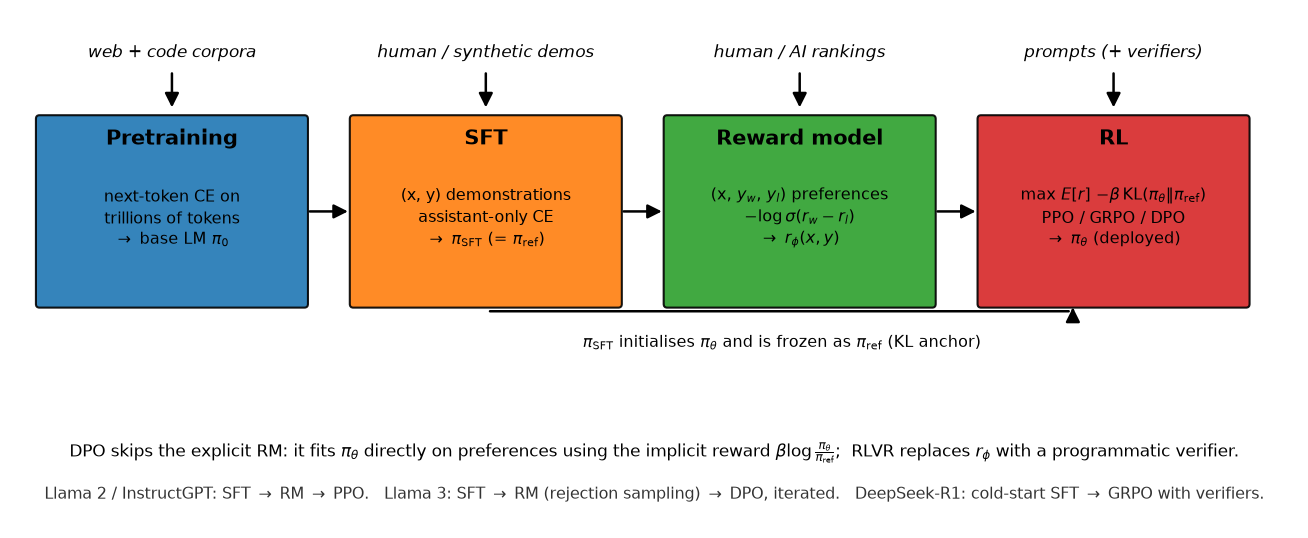
The figure shows the same four stages with the data that feeds each and the two places the reference policy is reused: it initialises the RL policy and it anchors the KL penalty.
Every stage is one objective applied to the same autoregressive model:
| Stage | Data | Objective | Output |
|---|---|---|---|
| SFT | \((x, y)\) demonstrations | \(-\sum_{t \in \text{assistant}} \log \pi_\theta(y_t \mid x, y_{<t})\) | \(\pi_{\mathrm{SFT}}\) |
| Reward model | \((x, y_w, y_l)\) | \(-\log \sigma\big(r_\phi(x,y_w) - r_\phi(x,y_l)\big)\) | \(r_\phi\) |
| RLHF (PPO) | prompts \(x\), online samples | \(\E[r_\phi(x,y)] - \beta\,\KL(\pi_\theta \,\|\, \pi_{\mathrm{ref}})\) | \(\pi_\theta\) |
| DPO | \((x, y_w, y_l)\) | \(-\log \sigma\big(\beta[\log\tfrac{\pi_\theta}{\pi_{\mathrm{ref}}}(y_w) - \log\tfrac{\pi_\theta}{\pi_{\mathrm{ref}}}(y_l)]\big)\) | \(\pi_\theta\) |
| RLVR / GRPO | prompts + verifier | group-normalised advantage, clipped ratio, \(k_3\) KL | \(\pi_\theta\) |
| Test-time compute | none (inference) | \(\max_{y_1..y_N} r(x, y_i)\), majority vote, search | better answers, more FLOPs |
Chapters¶
- Supervised fine-tuning: chat templates, assistant-only loss masks, packing with segment masks, data mixtures, synthetic data, why SFT overfits.
- Reward models & preferences: Bradley–Terry from first principles, RM architecture, calibration, over-optimisation scaling laws, ensembles, LLM-as-judge.
- RLHF with PPO: the KL-regularised objective, the clipped surrogate derived, GAE, the four-model memory footprint, generation as the bottleneck.
- DPO and its relatives: the closed-form optimum, the substitution that cancels the partition function, implicit rewards, IPO / ORPO / KTO / SimPO.
- Reasoning RL, RLVR & GRPO: verifiable rewards, GRPO derived, DAPO / Dr. GRPO, process rewards, reward hacking, RLAIF and Constitutional AI, DeepSeek-R1.
- Test-time compute: chain of thought, self-consistency, best-of-N and its KL cost, beam and tree search, compute-optimal inference, serving cost.
Prerequisites¶
- Pretraining data & objective: the next-token cross-entropy that SFT reuses unchanged.
- Fine-tuning & LoRA: parameter-efficient variants of everything here.
- Policy gradients, GAE & PPO: the policy-gradient theorem, GAE and PPO on a control task. Chapter 3 states those results and adds the LM specifics.
- Information theory: KL divergence, its estimators, entropy.
- Logistic & softmax regression: the Bradley–Terry loss is logistic regression on a reward difference.
- Inference systems and distributed training: why generation dominates RLHF wall-clock and how the four models are sharded.
The one-day ordering¶
If you have one day before an interview that touches post-training:
- Morning (3 h). Chapter 1 §2–3 (the mask and the packing mask; ten minutes each to retype), then chapter 2 §2 (derive Bradley–Terry from the logistic model, twice), then chapter 4 §2 (derive DPO end to end on paper without looking; this is the single most-asked derivation).
- Early afternoon (2 h). Chapter 3: the objective, where the KL enters the per-token reward, the clipped surrogate and why clipping is a trust region, the four-model memory table. Then chapter 5 §2: GRPO advantages and the \(k_3\) estimator; be able to say what DAPO changed and why.
- Late afternoon (1.5 h). Chapter 6: best-of-N's \(\log N - (N-1)/N\) bound, self-consistency, when tree search pays, compute-optimal inference. Then every chapter's TL;DR and §5 case studies: InstructGPT, Llama 2, Llama 3, Constitutional AI, DeepSeek-R1, Tülu 3.
- Evening (1 h). Run
pytest tests/test_posttrain_* -q, then retypedpo_loss,bradley_terry_loss,group_relative_advantages+grpo_lossandppo_clip_lossfrom memory against the tests.
Code map¶
All Part VII code is self-contained in src/mlbook/posttrain/ and runs on a tiny
explicit causal LM (toy_lm.py, ~50 k parameters) so that every algorithm trains on
a CPU in seconds:
| Module | What it implements | Test |
|---|---|---|
toy_lm.py |
TinyCausalLM, token_log_probs, sequence_log_prob, sample |
used by every test |
chat_template.py |
ToyTokenizer, render_chat, tokenize_chat (assistant mask) |
tests/test_posttrain_chat_template.py |
sft.py |
assistant_only_labels, sft_loss, pack_examples, packed_attention_mask, train_sft |
tests/test_posttrain_sft.py |
reward_model.py |
TinyRewardModel, bradley_terry_loss, train_reward_model |
tests/test_posttrain_reward_model.py |
ppo_lm.py |
shaped_rewards, gae, ppo_clip_loss, value_loss, AdaptiveKLController, train_ppo |
tests/test_posttrain_ppo.py |
dpo.py |
dpo_loss, ipo_loss, simpo_loss, orpo_loss, kto_loss, dpo_train_step |
tests/test_posttrain_dpo.py |
grpo.py |
group_relative_advantages, k3_kl, grpo_loss, train_grpo |
tests/test_posttrain_grpo.py |
verifiers.py |
arithmetic verifier, target-token reward, noisy SFT data | tests/test_posttrain_grpo.py |
test_time.py |
best_of_n, self_consistency, beam_search, bon_kl_bound |
tests/test_posttrain_test_time.py |